NOTE: The code and data used to produce all of the figures in this post can be found here.
Having forsworn blogging activity for several months in favour of actual dissertation work, I thought I'd mark a return to Stickman's Corral in time for the holidays. Our topic for discussion today is a poster (study?) by Cato Institute researchers, Patrick Michaels and "Chip" Knappenberger.
Michaels & Knappenberger (M&K) argue that climate models predicted more warming than we have observed in the global temperature data. This is not a particularly new claim and I'll have more to say about it generally in a future post. However, M&K go further in trying to quantify the mismatch in a regression framework. In so doing, they argue that it is incumbent upon the scientific community to reject current climate models in favour of less "alarmist" ones. (Shots fired!) Let's take closer look at their analysis, shall we?
In essence, M&K have implemented a simple linear regression of temperature on a time trend,
\begin{equation}
Temp_t = \alpha_0 + \beta_1 Trend + \epsilon_t.
\end{equation}
This is done recursively, starting from 2014 and incrementing backwards one year at a time until the sample extends until the middle of the 20th century. The key figure in their study is the one below, which compares the estimated trend coefficient, $\hat{\beta_1}$, from a bunch of climate models (the CMIP5 ensemble) with that obtained from observed climate data (global temperatures as measured by the Hadley Centre's HadCRUT4 series).
Since the observed warming trend consistently falls below that predicted by the suite of climate models, M&K conclude: "[A]t the global scale, this suite of climate models has failed. Treating them as mathematical hypotheses, which they are, means that it is the duty of scientists to reject their predictions in lieu of those with a lower climate sensitivity."
Bold words. However, not so bold on substance. M&K's analysis is incomplete and their claims begin to unravel under further scrutiny. I discuss some of these shortcomings below the fold.
Showing posts with label Climate Change. Show all posts
Tuesday, December 23, 2014
Tuesday, April 22, 2014
On economic "consensus" and the benefits of climate change
Note: Slight edits to graphs and text to make things clearer and more comparable.
Richard Tol is a man who likes to court controversy. I won't deem to analyse his motivations here -- suffice it to say that I respect his professional research at the same time as I find his social media interactions maddeningly obscure, churlish and inconsistent. However, I'm pretty sure that he relishes the the role of provocateur in the climate change debate and will admit no shame in that.
Little wonder then, that his work acts as grist to the mill for sceptical op-eds of a more -- shall we say --considered persuasion. That is, opinion pieces that at least try to marshal some credible scientific evidence against decisive climate change action, rather than just mouthing off some inane contrarian talking points (it's a giant communist conspiracy, etc). Bjørn Lomborg and Matt Ridley are two writers that have cited Richard's research in arguing forcibly against the tide of mainstream climate opinion. I want to focus on the latter's efforts today, since it ties in rather nicely with an older post of mine: "Nope, Nordhaus is still (mostly) right."
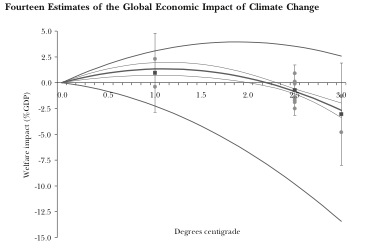
I won't regurgitate the whole post, but rather single out one aspect: The net benefits that climate change may or may not bring at moderate temperature increases. The idea is encapsulated in the following figure of Tol (2009), which shows estimates of economic damages due to temperature increases relative to the present day.
Now, there are various points to made about the implications of Fig. 1. People like Matt Ridley are wont to point out that it demonstrates how climate change will bring benefits to us long before it imposes any costs. Ergo, we should do little or nothing about reducing our emissions today. Of course, there are multiple responses to this position and I tried to lay out various reasons in my previous post as to why this is a very misleading take (sunk benefits and inertia in the climate system, uncertainty and risk aversion, unequal distribution of benefits and costs, tipping points, etc).
However, I have two broader points to make here, for which Ridley will prove a useful foil. For example, here he is in The Spectator last year, arguing "Why Climate Change Is Good For The World":
This is all very well-trodden ground by now, but it underscores just how tenuous -- to put it mildly -- Matt Ridely's appeal to economic consensus is. However, we are still left with a curve that purports to show positive benefits from climate change up until around 2˚C of warming, before turning negative. So here are my two comments:
Comment #1: Outlier and functional form
Given that only one study (i.e. Tol, 2002) among the 14 surveyed in Tol (2009) shows large-ish benefits from climate change, you may be inclined to think that the initial benefits suggested by Fig. 1 are hinged on this "outlier"... And you would not be wrong: individual observations will always stand to impact the overall outcome in small samples. However, I would also claim that such a result is partially an artefact of functional form. What do I mean by this? I mean that predicting positive benefits at "moderate" levels of warming is in some sense inevitable if we are trying to fit a quadratic function[*] to the limited data available in Tol (2009). This is perhaps best illustrated by re-estimating the above figure, but (i) correcting for the typos discovered by Bob Ward and (ii) excluding the outlier in question.
Remember that our modified sample includes only negative -- or neutral at best -- effects on welfare due to climate change. And yet, the new best-fit line (dark grey) suggests that we will still experience net benefits for a further 1.75˚C of warming! Thus we see how the choice of a quadratic function to fit our data virtually guarantees the appearance of initial benefits, even when the data themselves effectively exclude such an outcome.[**] You'll note that I am following Ridley's lead here in ignoring the confidence intervals. This is not a particularly sound strategy from a statistical perspective, but let's keep things simple for the sake of comparison.
Comment #2: New data points
As it happens, several several new estimates of the economic effects of climate change have been made available since Tol (2009) was published. Richard has updated his Fig. 1 accordingly and included it in the latest IPCC WG2 report. You can find it on pg. 84 here. (Although -- surprise! -- even this is not without controversy.) However, this updated version does not include a best-fit line. That is perhaps a wise choice given the issues discussed above. Nevertheless, like me, you may still be curious to see what it looks like now that we have a few additional data points. Here I have re-plotted the data, alongside a best-fit line and 95% confidence interval.
Whoops. Looks like those initial benefits have pretty much vanished!
So... What odds on Matt Ridley reporting the updated economic "consensus"?
UPDATE: Richard points me towards a recent working paper of his that uses non-parametric methods to fit a curve to the data. This is all well and good, and I commend his efforts in trying to overcome some of the issues discussed above... Except for one overwhelming problem: Non-parametric methods -- by their very nature -- are singularly ill-suited to small samples! Even Wikipedia manages to throw up a red flag in its opening paragraph on the topic: "Nonparametric regression requires larger sample sizes than regression based on parametric models because the data must supply the model structure as well as the model estimates." Arguably even more problematic is the fact that non-parametric estimations are particularly misleading in the tails. I simply don't see how a non-parametric approach can be expected to produce meaningful results, given that we are dealing with a rather pitiful 20-odd observations. Ultimately, it is not so much a question of parametric versus non-parametric. The real problem is a paucity of data.
UPDATE 2: An errata to Tol (2009) has finally been published. The updated figure is, of course, the same as much the same as I have drawn above. [Having looked a bit closer, I see the errata includes an additional data point that isn't in the IPCC report (Nordhaus, 2013). In addition, the damage figure given for another study (Roson and van der Mensbrugghe, 2012) has changed slightly. Yay for typos!]
UPDATE 3: Ouch... and double ouch. Statistician Andrew Gelman takes Richard out to the woodshed (making many of the same points that I have here). The result isn't pretty. Make sure to read the comments thread too.
___
[*] Tol (2009) uses a simple regression equation of D = b1*T - b2*T^2 to fit the data. He finds b1 = 2.46 and b1 = 1.11, which is where the thick, central grey line in Fig. 1 comes from.
[**] For the record, I don't wish to come across as overly pedantic or critical of the choice of a quadratic damage function. Indeed, it is hard to think of another simple function that would better lend itself to describing the effect of moderate temperature increases. (Albeit not for higher levels of warming.) I am merely trying to expand on the way in which the interplay of limited data and choice of functional form can combine to give a misleading impression of the risks associated with climate change.
Richard Tol is a man who likes to court controversy. I won't deem to analyse his motivations here -- suffice it to say that I respect his professional research at the same time as I find his social media interactions maddeningly obscure, churlish and inconsistent. However, I'm pretty sure that he relishes the the role of provocateur in the climate change debate and will admit no shame in that.
Little wonder then, that his work acts as grist to the mill for sceptical op-eds of a more -- shall we say --considered persuasion. That is, opinion pieces that at least try to marshal some credible scientific evidence against decisive climate change action, rather than just mouthing off some inane contrarian talking points (it's a giant communist conspiracy, etc). Bjørn Lomborg and Matt Ridley are two writers that have cited Richard's research in arguing forcibly against the tide of mainstream climate opinion. I want to focus on the latter's efforts today, since it ties in rather nicely with an older post of mine: "Nope, Nordhaus is still (mostly) right."
I won't regurgitate the whole post, but rather single out one aspect: The net benefits that climate change may or may not bring at moderate temperature increases. The idea is encapsulated in the following figure of Tol (2009), which shows estimates of economic damages due to temperature increases relative to the present day.
![]() |
| Fig. 1 Note: Dots represent individual studies. The thick centre line is the best fit stemming from an OLS regression: D = 2.46T - 1.11T^2, with an R-squared value of 0.51. The outer lines are 95% confidence intervals derived according to different methods. Source: Tol (2009) |
Now, there are various points to made about the implications of Fig. 1. People like Matt Ridley are wont to point out that it demonstrates how climate change will bring benefits to us long before it imposes any costs. Ergo, we should do little or nothing about reducing our emissions today. Of course, there are multiple responses to this position and I tried to lay out various reasons in my previous post as to why this is a very misleading take (sunk benefits and inertia in the climate system, uncertainty and risk aversion, unequal distribution of benefits and costs, tipping points, etc).
However, I have two broader points to make here, for which Ridley will prove a useful foil. For example, here he is in The Spectator last year, arguing "Why Climate Change Is Good For The World":
To be precise, Prof Tol calculated that climate change would be beneficial up to 2.2˚C of warming from 2009[... W]hat you cannot do is deny that this is the current consensus. If you wish to accept the consensus on temperature models, then you should accept the consensus on economic benefit.Bold in my emphasis. Now it should be pointed out that Ridley's articled elicited various responses, including one by Bob Ward that uncovers some puzzling typos in Richard's paper. Ward goes on to show that in fact only two out of the 14 studies considered in Tol (2009) reveal net positive benefits accruing due to climate change, and one of these was borderline at best. Specifically, Mendelsohn et al. (2000) suggest that 2.5˚C of warming will yield a tiny net global benefit equivalent to 0.1% of GDP. (It is should also be noted that they do not account for non-market impacts -- typically things like ecosystems, biodiversity, etc -- which would almost certainly pull their estimate into negative territory.) That leaves one of Richard's own papers, Tol (2002), which suggests that 1˚C of warming will yield a 2.3% gain in GDP, as the sole study showing any kind of benefits due to climate change.
This is all very well-trodden ground by now, but it underscores just how tenuous -- to put it mildly -- Matt Ridely's appeal to economic consensus is. However, we are still left with a curve that purports to show positive benefits from climate change up until around 2˚C of warming, before turning negative. So here are my two comments:
Comment #1: Outlier and functional form
Given that only one study (i.e. Tol, 2002) among the 14 surveyed in Tol (2009) shows large-ish benefits from climate change, you may be inclined to think that the initial benefits suggested by Fig. 1 are hinged on this "outlier"... And you would not be wrong: individual observations will always stand to impact the overall outcome in small samples. However, I would also claim that such a result is partially an artefact of functional form. What do I mean by this? I mean that predicting positive benefits at "moderate" levels of warming is in some sense inevitable if we are trying to fit a quadratic function[*] to the limited data available in Tol (2009). This is perhaps best illustrated by re-estimating the above figure, but (i) correcting for the typos discovered by Bob Ward and (ii) excluding the outlier in question.
![]() |
| Fig. 2 Based on Figure 1 in Tol (2009), but corrected for typos and including an additional best-fit line that excludes the most optimistic estimate of benefits due to moderate climate change (i.e. Tol, 2002). |
Remember that our modified sample includes only negative -- or neutral at best -- effects on welfare due to climate change. And yet, the new best-fit line (dark grey) suggests that we will still experience net benefits for a further 1.75˚C of warming! Thus we see how the choice of a quadratic function to fit our data virtually guarantees the appearance of initial benefits, even when the data themselves effectively exclude such an outcome.[**] You'll note that I am following Ridley's lead here in ignoring the confidence intervals. This is not a particularly sound strategy from a statistical perspective, but let's keep things simple for the sake of comparison.
Comment #2: New data points
As it happens, several several new estimates of the economic effects of climate change have been made available since Tol (2009) was published. Richard has updated his Fig. 1 accordingly and included it in the latest IPCC WG2 report. You can find it on pg. 84 here. (Although -- surprise! -- even this is not without controversy.) However, this updated version does not include a best-fit line. That is perhaps a wise choice given the issues discussed above. Nevertheless, like me, you may still be curious to see what it looks like now that we have a few additional data points. Here I have re-plotted the data, alongside a best-fit line and 95% confidence interval.
![]() |
| Fig. 3 Based on Figure 10 in IPCC WG2 (2014). As before, the best-fit line is computed according a quadratic function using OLS. This yields D = 0.01T - 0.27T^2, with an R-squared value of 0.49. |
So... What odds on Matt Ridley reporting the updated economic "consensus"?
UPDATE: Richard points me towards a recent working paper of his that uses non-parametric methods to fit a curve to the data. This is all well and good, and I commend his efforts in trying to overcome some of the issues discussed above... Except for one overwhelming problem: Non-parametric methods -- by their very nature -- are singularly ill-suited to small samples! Even Wikipedia manages to throw up a red flag in its opening paragraph on the topic: "Nonparametric regression requires larger sample sizes than regression based on parametric models because the data must supply the model structure as well as the model estimates." Arguably even more problematic is the fact that non-parametric estimations are particularly misleading in the tails. I simply don't see how a non-parametric approach can be expected to produce meaningful results, given that we are dealing with a rather pitiful 20-odd observations. Ultimately, it is not so much a question of parametric versus non-parametric. The real problem is a paucity of data.
UPDATE 2: An errata to Tol (2009) has finally been published. The updated figure is, of course,
UPDATE 3: Ouch... and double ouch. Statistician Andrew Gelman takes Richard out to the woodshed (making many of the same points that I have here). The result isn't pretty. Make sure to read the comments thread too.
___
[*] Tol (2009) uses a simple regression equation of D = b1*T - b2*T^2 to fit the data. He finds b1 = 2.46 and b1 = 1.11, which is where the thick, central grey line in Fig. 1 comes from.
[**] For the record, I don't wish to come across as overly pedantic or critical of the choice of a quadratic damage function. Indeed, it is hard to think of another simple function that would better lend itself to describing the effect of moderate temperature increases. (Albeit not for higher levels of warming.) I am merely trying to expand on the way in which the interplay of limited data and choice of functional form can combine to give a misleading impression of the risks associated with climate change.
Monday, October 21, 2013
Joe Romm's cognitive dissonance on renewables, nuclear and shale gas
I used to be an avid reader of Joe Romm's "Climate Progress" blog. However, my enthusiasm has waned dramatically over the years due to his selective presentation of facts and data, stark intolerance for any opposing ideas and dogmatic stance on nuclear power. (On the plus side, his blog remains an excellent repository for climate news and he can be great fun when mocking the likes of Christopher Monckton.)
Probably the biggest problem that I have with Romm, however, is that he appears to suffer from acute cognitive dissonance. For example, the overriding theme of his blog is one of impending climate doom, yet he regularly proclaims that renewables are already at grid parity, getting cheaper by the second and ready for mass deployment. So, problem solved surely? Frustratingly, this is a recurrent theme on many green blogs, where Cassandra complexes are hard to square with wildly overstated -- or misleading at best -- claims about current renewable energy performance.
Such cognitive dissonance is again on display in one of Romm's recent posts, entitled "Major Study Projects No Major Long-Term Benefit From Shale Gas Revolution". The study in question is by Huntington et al, (2013) and contains projections from a broad suite of integrated climate models. In addition to GHG emissions, the researchers looked at the wider economic impacts of shale gas and their conclusions are rather more nuanced than Romm's excitable headline would suggest. In short, the final projections depend on a complex set of model assumptions and variable interactions. This is evident from the following paragraph that Romm actually cites from the study (emphasis his):
More importantly, to say that shale gas confers no long-term climate benefits (in of itself) is extremely misleading. It all depends on whether it is complemented by a carbon price, as anyone interested in this debate (at least that I am aware of) readily acknowledges. You get a sense of this from the very figure that Joe Romm chooses to include in his blog post:
The dramatic reduction in emissions due to a carbon price is clearly evident. However, the above figure is still not really comparing apples with apples, since the carbon price is not adapted to the high shale scenario. (It is applied to a reference scenario that is somewhere in between the high and low shale cases.) Luckily, the data that would allow us to make the correct comparison is available here. I have therefore reconstructed the above graph, this time adding a new column that specifically combines the high shale scenario with a carbon price.
This updated graph makes perfectly clear that the shale revolution can be fully compatible with deep long-term emission reductions, as long as it is complemented by a carbon price. To his credit, Romm does mention this briefly in the article and has also commented on the issue previously. Yet, by continuing to disparage shale gas and pretend that its supporters ignore the need for a carbon price, he simply serves to further polarise the climate debate.
THOUGHT FOR THE DAY: Adapting to the threat of climate change will require a broad suite of interventions. Nobody should claim that the proliferation of shale gas is a sufficient development for de-carbonising the global economy. However, together with a carbon price and other technological breakthroughs, it will likely form a very necessary component.
PS - It probably goes without saying that the economy also benefits from cheap and abundant shale. Huntington et al. state as much in their report (p. 7):
Probably the biggest problem that I have with Romm, however, is that he appears to suffer from acute cognitive dissonance. For example, the overriding theme of his blog is one of impending climate doom, yet he regularly proclaims that renewables are already at grid parity, getting cheaper by the second and ready for mass deployment. So, problem solved surely? Frustratingly, this is a recurrent theme on many green blogs, where Cassandra complexes are hard to square with wildly overstated -- or misleading at best -- claims about current renewable energy performance.
Such cognitive dissonance is again on display in one of Romm's recent posts, entitled "Major Study Projects No Major Long-Term Benefit From Shale Gas Revolution". The study in question is by Huntington et al, (2013) and contains projections from a broad suite of integrated climate models. In addition to GHG emissions, the researchers looked at the wider economic impacts of shale gas and their conclusions are rather more nuanced than Romm's excitable headline would suggest. In short, the final projections depend on a complex set of model assumptions and variable interactions. This is evident from the following paragraph that Romm actually cites from the study (emphasis his):
…this trend towards reducing emissions becomes less pronounced as natural gas begins to displace nuclear and renewable energy that would have been used otherwise in new power plants under reference case conditions. Another contributor to the modest emissions impact is the somewhat higher economic growth that stimulates more emissions. Reinforcing this trend is the greater fuel and power consumption resulting from lower natural gas and electricity prices.Does anyone else see the irony here? Romm is lauding a study which questions the climate credentials of shale gas... and yet that largely depends on whether cheap gas displaces nuclear power -- a technology that he maligns at every opportunity.
More importantly, to say that shale gas confers no long-term climate benefits (in of itself) is extremely misleading. It all depends on whether it is complemented by a carbon price, as anyone interested in this debate (at least that I am aware of) readily acknowledges. You get a sense of this from the very figure that Joe Romm chooses to include in his blog post:
![]() |
| Comparison of low shale scenario (light blue), high shale scenario (dark blue), and a scenario depicting a reference case combined with a carbon price (green). This reference case is in between the low and high shale scenarios, while the carbon price starts at $25/tonne in 2013 and increases at 5% each year. Source: Huntington et al. (2013). |
The dramatic reduction in emissions due to a carbon price is clearly evident. However, the above figure is still not really comparing apples with apples, since the carbon price is not adapted to the high shale scenario. (It is applied to a reference scenario that is somewhere in between the high and low shale cases.) Luckily, the data that would allow us to make the correct comparison is available here. I have therefore reconstructed the above graph, this time adding a new column that specifically combines the high shale scenario with a carbon price.
![]() |
| Based on Figure 13 of Huntington et al. (2013). The figure now includes a fourth column (purple) where a high shale scenario is combined with a carbon price. |
This updated graph makes perfectly clear that the shale revolution can be fully compatible with deep long-term emission reductions, as long as it is complemented by a carbon price. To his credit, Romm does mention this briefly in the article and has also commented on the issue previously. Yet, by continuing to disparage shale gas and pretend that its supporters ignore the need for a carbon price, he simply serves to further polarise the climate debate.
THOUGHT FOR THE DAY: Adapting to the threat of climate change will require a broad suite of interventions. Nobody should claim that the proliferation of shale gas is a sufficient development for de-carbonising the global economy. However, together with a carbon price and other technological breakthroughs, it will likely form a very necessary component.
PS - It probably goes without saying that the economy also benefits from cheap and abundant shale. Huntington et al. state as much in their report (p. 7):
Higher shale resources reduce the costs of natural gas development and expand opportunities throughout the economy. Relative to its path in the low-shale case, [real GDP] is higher in all models that track the economy’s aggregate output. The cumulative aggregation of these GDP gains over all years is significant standing at $1.1 trillion (2010 dollars).
Showing this in graphical form is a little trickier, since some of the models actually take economic growth as an exogenous assumption, or don't extend all the way until 2050. Nonetheless, here is a graph showing a selection of models that compare changes in real GDP up until 2035.
Thursday, October 17, 2013
Manufactured controversy and the "hockey stick": A football analogy
Even if you're only vaguely aware of the climate change debate, then you will probably have heard of the "hockey stick". You know, this bad boy:
This famous depiction of global temperatures going back into time has generated a lot of controversy. It doesn't seem to matter much to sceptics that the initial hockey stick(s) -- i.e. those produced by Mann, Bradley and Hughes (1998, 1999) -- have since been replicated by multiple studies using different lines of evidence and computational procedures. No, we are invariably told that the hockey stick is a fraud and has been debunked by the likes of Steve McIntyre and Ross McKitrick.
The problem with these debates is that they are necessarily technical and involve concepts that are very unfamiliar to most people. Whenever I tried to explain things to my friends and family, I could see their eyes glazing over as soon as I mentioned the words "principal component analysis". So here is a sports analogy that captures the essence of what critics like McIntyre and McKitrick got wrong.
| Source: Mann et al. (1999). |
The problem with these debates is that they are necessarily technical and involve concepts that are very unfamiliar to most people. Whenever I tried to explain things to my friends and family, I could see their eyes glazing over as soon as I mentioned the words "principal component analysis". So here is a sports analogy that captures the essence of what critics like McIntyre and McKitrick got wrong.
Thursday, September 12, 2013
China to reduce coal consumption?
I've tried to emphasise the importance of relative concepts many times on this blog. However, there are occasions when relative measures can also be more than a little misleading. Case in point: This article from Reuters, which describes how China plans to reduce its coal consumption to 65% of primary energy by 2017.
This policy prescription is primarily motivated by desire to improve the country's terrible air pollution. Of course, a reduction in coal will also bring climate benefits. (I have previously talked about the "co-benefits" of climate policy and local air pollution measures here.)
However, despite being a tentative step in a right direction, this is hardly a watershed moment. In fact, the US Energy Information Agency (EIA) was already forecasting a drop in Chinese coal consumption to 65% of total energy by 2017 (from 69% in 2012) in the reference scenario of its International Energy Outlook, which was published earlier this year.
More importantly, this relative decrease glosses over the fact that the absolute consumption of coal is forecast to increase by nearly 20% over the same period... Up from 79.2 quadrillion Btu in 2012 to an eye-watering 94.1 quad Btu in 2017!
THOUGHT FOR THE DAY: Be wary of anyone who tells you that China is leading the race in de-carbonising their economy, or winning the battle on renewables for that matter. There may be an element of truth in such statements, but the bigger picture is far more sobering.
This policy prescription is primarily motivated by desire to improve the country's terrible air pollution. Of course, a reduction in coal will also bring climate benefits. (I have previously talked about the "co-benefits" of climate policy and local air pollution measures here.)
However, despite being a tentative step in a right direction, this is hardly a watershed moment. In fact, the US Energy Information Agency (EIA) was already forecasting a drop in Chinese coal consumption to 65% of total energy by 2017 (from 69% in 2012) in the reference scenario of its International Energy Outlook, which was published earlier this year.
More importantly, this relative decrease glosses over the fact that the absolute consumption of coal is forecast to increase by nearly 20% over the same period... Up from 79.2 quadrillion Btu in 2012 to an eye-watering 94.1 quad Btu in 2017!
![]() |
Source: EIA data tool |
THOUGHT FOR THE DAY: Be wary of anyone who tells you that China is leading the race in de-carbonising their economy, or winning the battle on renewables for that matter. There may be an element of truth in such statements, but the bigger picture is far more sobering.
Wednesday, September 4, 2013
How methane emissions could actually be good for the climate
This was the title of a post I wrote last week for the Recon Hub.
It may seem like I am merely trolling for viewer hits here. However, the logic behind this counter-intuitive statement is based on the political factors that shape people's opinion on climate change. (E.g. Rather depressingly, support for the theory of man-made climate change increases when the weather is hotter.)
The other important thing to realise is that methane is a much more powerful greenhouse gas than CO2 over the short-term. Yet, it's potency fades the further we look into the future, whereas CO2 remains in the atmosphere for millennia.
Here's the take-home:
It may seem like I am merely trolling for viewer hits here. However, the logic behind this counter-intuitive statement is based on the political factors that shape people's opinion on climate change. (E.g. Rather depressingly, support for the theory of man-made climate change increases when the weather is hotter.)
The other important thing to realise is that methane is a much more powerful greenhouse gas than CO2 over the short-term. Yet, it's potency fades the further we look into the future, whereas CO2 remains in the atmosphere for millennia.
Here's the take-home:
Tying everything together, a move to natural gas might conceivably benefit the long-term climate in two ways. First, there is simply a direct elimination of carbon emissions due to the switching away from coal. This obviously presumes that fugitive methane leakages are not high enough to offset those gains. However, even that runs parallel to a second point which has been the focus of this post: Methane emissions in the present will drive up temperatures (but not over the long-term) in a way that likely encourages political action and hopefully helps to establish a coherent climate policy.
To conclude, I’d rather see global temperatures follow a concave path over the coming decades, than a convex one. In less technical terms: Accepting an acceleration in near-term temperatures in order to secure the political will necessary to enact long-term climate policy, seems an acceptable trade-off from my perspective.
Saturday, August 3, 2013
Advocacy and climate research
The latest furore to erupt in the climate blogosphere concerns whether climate scientists undermine their credibility by engaging in advocacy? (For some responses, see James Annan, Gretchen Goldman and HB&H.)
As it happens, I recently wrote a term-paper on this exact issue for my philosophy of science class. I've decided to make it available here for those who are interested in this debate!
To summarise, I don't see anything inherently wrong with scientists engaging in political advocacy, as long as they are explicit in their intentions... and the scope of their expertise. (E.g. I often see physical scientists make strong pronouncements about economic matters and that makes me uncomfortable.) One climate scientist whom I feel always struck a good balance on these issues and quote in my term-paper is the late Stephen Schneider. To channel Schneider: Our response to climate change must be underpinned by scientific facts, but it should ultimately also be reflective of society's value judgements -- including those of our scientists.
Some brief points/caveats:
UPDATE: I've just finished listening to a very interesting discussion between the climate scientists, Gavin Schmidt, Richard Betts and Judith Curry, on this precise topic. I am again struck by something that was very clear to me whilst researching my essay: The various sides all seem to agree on the principles (i.e. being open about one’s area of expertise and clear on your value judgements when advocating for policy). The real sticking point appears to be one of application.
As it happens, I recently wrote a term-paper on this exact issue for my philosophy of science class. I've decided to make it available here for those who are interested in this debate!
To summarise, I don't see anything inherently wrong with scientists engaging in political advocacy, as long as they are explicit in their intentions... and the scope of their expertise. (E.g. I often see physical scientists make strong pronouncements about economic matters and that makes me uncomfortable.) One climate scientist whom I feel always struck a good balance on these issues and quote in my term-paper is the late Stephen Schneider. To channel Schneider: Our response to climate change must be underpinned by scientific facts, but it should ultimately also be reflective of society's value judgements -- including those of our scientists.
Some brief points/caveats:
- This was a “pass/fail” essay, aimed at gaining admission to sit the exam, and I hope that you’ll evaluate the material accordingly. That said, the emphasis on citations and quotations probably means that it provides a good overview of the issues.
- Apart from scientists working on the physical basis for climate change, I also tried to pay special attention to the role of economists. The Stern Review, which many people regard as the archetypal blend of economics and advocacy, therefore comes in for special attention.
Click to read the term-paper.
Tuesday, May 21, 2013
I, for one, welcome our new technocratic, environmentalist, socialist overlords
Any group that successfully manages to perpetrate a hoax involving tens of thousands of individuals from all over the world... would sure be able to elect a politburo of unimagined efficiency.
Ninety-seven percent agreement collusion conspiracy among climate scientists? One can only imagine how effortlessly they will get the trains to run on time, or tame the business cycle.
The future never looked so bright.
[Note to self: File under right-wing paradoxes.]
Thursday, April 11, 2013
Energy Collective post - Natural gas and long-term climate goals
I should perhaps have mentioned this last Friday when it was published, but my new post for The Energy Collective is up: Bridging the Gap? Natural gas and long-term climate change goals.
As the title suggests, my aim is to explore whether the scientific evidence supports the much-touted notion of gas as a "bridge fuel" (i.e. towards a low-carbon economy). This a hotly debated topic, with a lot of excited rhetoric and dubious assertion clouding the issue. Luckily, I've read it all so that you don't have to! A snippet:
However, even this is not to say that natural gas lacks credibility as the most viable, climate-friendly alternative to coal. Unpalatable as it will be for some people, the unavoidable conclusion from my perspective is that achieving very stringent emissions targets will always depend on a hefty slice of fortune… It is certainly no accident that studies which demonstrate hypothetical pathways towards achieving such targets must inevitably make fairly heroic assumptions – whether that be in the form of changes to economic behaviour and institutional reform, or in the presumption of substantial technology breakthroughs. In that light, it is not entirely obvious to me why CCS-enabled gas plants should be regarded as more unlikely than, say, thorium nuclear. And it certainly isn’t obvious to me that climate activists are best serving their cause by demonizing the one fuel source that has provably shaken coal’s grip on the global energy system.
PS - My post on Hugo Chavez and Margaret Thatcher has also been reposted at TEC -- with an updated intro in light of recent events.
Sunday, March 31, 2013
New writing gig - The Energy Collective
Some exciting news for yours truly is that I'll be writing a series of articles for the excellent energy and climate website, The Energy Collective, as part of their Future Energy Fellows initiative.
Click through to read more!
I will be focusing on particular sub-topic that has aroused a lot of interest recently; namely, the economic and environmental impacts of natural gas.
My first post concerns the role that the North American shale boom has played in bringing U.S. carbon emissions to a twenty-year low, and the question of whether these climate gains are undermined by increased coal exports to Europe. (Short answer: not really.) The article expands on some earlier musings that I have presented here at the Corral and at the Recon Hub. Here's the opening gambit, which I use to set up the problem:
U.S. Shale Gas Meets European Climate Policy
Economists are suckers for a good paradox. Few things are more intellectually appealing to the practicing economist than a result which runs counter to his or her immediate intuition. Indeed, some of the most enduring ideas in history of economic thought have surprising implications at the heart of their allure; from the paradox of thrift to Ricardo's law of comparative advantage. For their part, the specialized fields of energy and environmental economics are not immune to the charms of counter-intuitive theories either. This includes textbook favourites like the green paradox and the rebound effect.
Beyond the intellectual appeal, it is clearly sensible to be mindful of such factors when designing policy. However, our inherent affinity for paradoxes is also problematic in that it can cause people to overstate their role in real world situations. To illustrate using the aforementioned rebound effect, Nature recently published a comprehensive literature survey on the subject by Gillingham et al. (2013). The authors show that the rebound effect’s significance is much overplayed, being typically only in the region of 10% (with an upper bound of about 30%). Hardly a compelling objection to improved efficiency standards then.[...]
Click through to read more!
Sunday, January 20, 2013
Review - Extreme Environment (Ivo Vegter)
Extreme Environment (hereafter EE) is a book written by South African journalist, Ivo Vegter. I have mentioned Vegter before on this blog and he generously arranged for me to be sent a free copy of EE after I offered to review it in an online discussion. Given this, and seeing as some of other reviews that I have read are disappointingly superficial, I decided to provide a chapter-by-chapter overview and criticism. I hope that you'll excuse the subsequent length of this post in exchange for some added thoroughness. (If not, a condensed version of this review can be found here.)
The major premise of EE is straightforward: Environmentalists are guilty of making grossly exaggerated claims and the green movement should in general be regarded with extreme scepticism. I fully endorse the more measured observation of the book jacket, which is that we should be just as cautious of the emotive rhetoric of environmentalists, as we are of corporate spin. EE expands on this dictum with varying degrees of success and some parts of the book are undoubtedly more convincing (and fairly presented) than others. It should be said that Vegter is not immune to moments of unfounded hyperbole himself, stating as early on as page 3 that the car could not have been invented in today's world, because it "would never have passed modern safety and environmental rules". (Talk about exaggeration!)
Sunday, December 23, 2012
Gas booms and carbon leakage
Following what I hope is my last written exam ever earlier this month, I must apologise for the sporadic posting of late. You see, I've also made my way home for a surprise visit to see the family and life is very much in the slow lane at the moment. (This is what we are dealing with, folks.)
Nonetheless, I did manage to write up something for the Recon Hub last week.Contrary to some negative Nigels, I argue that the availability of cheap American gas will not result in U.S. coal flooding the export market (and thereby undermining climate efforts on a global scale). The reason for this is that Europe has a cap-and-trade system in place and that means imported U.S. coal might displace coal from other regions, but not in a way that leads to materially higher emissions.
Gas Booms and Carbon leakage
... It seems to me that most commentators are missing something quite fundamental. Namely, that Europe has an emissions trading scheme in the form of the EU ETS. This arrangement naturally places a cap on the total level of emissions, so that the influx of cheap American coal should matter little from a climate perspective. After all, the beauty of a cap-and-trade system is that it guarantees environmental effectiveness in a way that is indifferent of how you might achieve it. As long as the cap remains in place, the market can be allowed to figure out the most efficient way of reaching it. (The climate doesn’t care if CO2 emissions come from burning American or Polish coal, so why should we?)
The current situation also points towards an interesting strategic development. Thus far, Europe has effectively acted alone in establishing a multi-national carbon market with binding emissions targets. A chief criticism of this unilateral approach is that it could ultimately just encourage carbon leakage, as polluting firms and fuel sources move to regions without binding targets. However, I have just described a scenario that largely precludes such an outcome. The proliferation of domestic gas resources may be forcing U.S. coal producers to look elsewhere, but the EU ETS places concrete limits how much of an effect this can have on global emissions.
...
Monday, May 14, 2012
Murphy vs Nordhaus vs Me summarized
It might be difficult to keep track of things in my previous post, because the lengthy discussion involves numerous claims and counterclaims. With the aim in simplifying things, here is a comment that I left on Daniel Kuehn's blog. I think that it provides a decent summary of my views:
Regarding "dancing around the issues"... Bob, my point here is that by choosing to interpret the WSJ skeptics (and Nordhaus' response) the way you do, you are either: a) Ignoring the obvious implications that they intended for their readers, or b) Rendering their specific claims as trivialities.
E.g. If you seriously believe that the skeptic claim about temperatures this decade -- i.e. "they have been flat" -- was not meant to convey any deeper message about future climate trends, do you then think that this observation is of any real use in of itself? Of course, if you think that it does say something important about long-term climate trends, which is the only thing that really matters in this debate, then you are back to the Nordhaus' response.
The Tol article is separate to the above and I do think that you highlight an important point regarding the net benefits associated with modest warming. Not many people understand this and you claim that Nordhaus badly misleads his readers by saying "Richard Tol finds a wide range of damages, particularly if warming is greater than 2 degrees"... despite the fact that Tol's own graph clearly shows net benefits up until that point. [See here - Ed.]
My response is that Tol specifically deals with this issue in his paper. He points out that these are "sunk" benefits, which we stand to accrue regardless of our policy choices today. The inertia in our climatic and economic systems will already ensure that we reach the edge of these positive gains from warming (due to increased agricultural yields, etc). Any action that we take against CO2 emissions today are solely aimed at tackling temperatures above two degrees, i.e. where things start heading into serious negative territory.
Bob, may I ask you whether you think your IER article helped readers understand this crucial point?
Sunday, May 13, 2012
Nope, Nordhaus is still (mostly) right
[NB: See the UPDATE at the bottom of this post.]
Following our previous tête-à-tête on the Heartland Affair, here's a response to Bob Murphy's latest post on climate change.
In the interests of keeping this as a brief as possible, let me just say that my post follows a back-and-forth involving different groups of people. My aim here isn't to give an overview to the entire discussion, but rather to reply directly to Bob's key points. However, the four act summary is as follows...
Now that you've seen the plot spoiler, let's go through some details:
1) Global Temperatures Have Been Flat for a Decade
Bob claims that Nordhaus is using a rhetorical slight of hand in addressing the skeptic claim that global temperatures have not increased in 10 years. Nordhaus does this by referring to the instrumental temperature record, which dates back to the 19th century and shows a clear warming trend. Bob claims that this isn't fair, since "no warming in the last decade" and "no warming since 1880" are different statements.
To be frank, this is simply dancing around the issue. If the original claim was meant to serve no purpose beyond itself, then perhaps that would be okay. (Vacuous, but okay.) However, the implication and inference of the skeptics' original statement was abundantly clear: Global warming has stopped, so all this talk about dangerous increases in future temperatures is probably bunk.[*] Nordhaus rightly points out that this is a meaningless observation and that only long-term trends can provide proper context. However, Bob tries to head off this approach too, by providing a long-term graph with rescaled Y-axis; ostensibly to show that temperatures have hardly changed in absolute terms over the last 150 years.
This is simply disingenuous. Let's conduct a simple thought experiment to show why. Imagine that observed warming since the Industrial Revolution isn't caused by mankind, but rather some combination of natural factors. Let's posit that the observed long-term trend due to this natural forcing trend continues unabated, so that temperatures eventually exceed pre-industrial levels by more than 2°C. Will there be economic costs associated with this, relative to a world without warming? Well, according to virtually every single study on the matter, the answer is a clear "YES". If it wasn't, then we wouldn't even be having this discussion... Why do you think adaptation through economic growth is taken so seriously -- not least of all, by prominent contrarians? (Also, see #3 below.)
The take home message is this: Seemingly small changes on the global scale will have tremendous impacts on the climate and natural systems that we depend on. For instance, a 3°C rise in average global temps will correspond to a world that probably hasn't existed for millions of years, entailing massive unknowns and downside risks. Further, the changes in regional temperatures will actually be far more acute, even if these "balance out" to some extent at a global level. (This point is often sadly overlooked by the focus on global averages.)
2) Actual Global Warming Has Been Smaller Than What the Models Predicted
Bob largely bases his comments here on a Master Resource blog post, which in turn cites a paper by Santer et al. (2011). Now, the main purpose of this study is quite technical in that it aims to show how different timescales can affect the ability to distinguish between climate "noise" and "signal". (Ironically, their bottom line is that we gain no understanding of climate change drivers simply by looking at the temperature record from a single decade.) However, we don't really need to concern ourselves with that here. The relevant issue -- and the one that Bob limits his discussion to -- relates to the below graph. It shows temperature measurements of the lower troposphere (TLT), as "observed" by two satellites (RSS and UAH) and predicted by climate models. Without going into specific details, Bob uses this as evidence to suggest that climate models exaggerate the warming effect in comparison to what reality will turn up.
Allow me to make two comments in response. The first thing to note is that satellite temperature measurements appear to suffer from an unresolved cooling bias.[**] Santer et al. (ibid, p. 10) actually highlight this issue in their paper:
As for the assertion that Nordhaus is arguing against a strawman by focusing on the role that human activity has played in driving climate change, versus the alternative (weaker?) claim that the models have simply overestimated warming full stop... Let's consider the original WSJ op-ed again: "The lack of warming for more than a decade[...] suggests that computer models have greatly exaggerated how much warming additional CO2 can cause." (Emphasis added.) You could perhaps argue that the statement is ambiguous, but I certainly don't think that Nordhaus is unjustified in highlighting the fact that, only by including CO2 alongside natural forcings, can we square model predictions with observed warming.
For more on the track record of computer models in predicting actual climate outcomes (including reconstructions of the past), see here.
3) CO2 Is Not a Pollutant / CO2 Poses No Harm to Humans
Now we get down to actual economics. Bob declares his unwillingness to wade into a semantic battle of how we define a pollutant... A smart move on his part, since defending the banal assertion that "CO2 can't be harmful because we, like, exhale it and stuff" -- a point that the WSJ skeptics effectively make -- could only lead to much wailing and gnashing of teeth. Instead, he thinks that he's caught Nordhaus at his own game by taking a deeper look at a study that he (i.e. Nordhaus) references in support of his arguments. The paper in question is a literature survey by Richard Tol (2009) entitled "The Economic Effect of Climate". The key figure is below, which Bob uses to claim that CO2 rise will bring net benefits; at least up until two degrees warming. [UPDATE: Bob Ward points out several typos in Tol's paper, which would bring the onset of (expected) negative effects forward. See here for an updated version of the below figure on the And Then There's Physics blog.]
Now, Bob is qualitatively correct here; several studies indicate that there are net gains to be had from some moderate level of warming. (Incidentally, this is not something that Nordhaus would appear to dispute.) There are several reasons for such benefits, including increased agricultural production in certain parts of the world. However, some crucial points must be emphasised:
4) Nordhaus’ Own Work Shows Harms of Government Intervention
Okay, Bob is quick to say that the WSJ skeptics "screwed up" here. Anyone that has read Nordhaus's work knows that he as long called for Governments to put a price on carbon. Still, Bob now offers up one of this own papers to show that... well, it would seem that changing various factors in a climate model can lead to substantially different results. To be honest, I'm not entirely sure what to do with this. Admittedly, I haven't read Bob's paper -- I'll hopefully do so when I get time -- but in his blog post at least he is making some pretty unremarkable points. For instance, Al Gore apparently has some very bad policy recommendations. Okay, but Nordhaus never mentions Gore in his essay and neither do the 16 WSJ skeptics. (Personally, I'm not particularly interested in what AG has to say about the economics of climate change and I certainly can't think of any major nation pushing for 90 percent emission reductions by 2050.) As for the fact that Nordhaus "assumes" that his calibrated carbon tax will be perfectly implemented over time... Um, yes, that's how benchmarks work. We describe the first-best scenario and then look at how deviations from that optimum will impact results.
Nevertheless, let me try to reply in kind by saying that I, too, have nagging problems with Nordhaus' methodology. In particular, using observed market rates for making normative judgments and implicitly assuming perfect substitutability between man-made and natural goods. I have previously written about these issues here and here.
THOUGHT FOR THE DAY: The Wall Street Journal continues to push climate change opinion that is highly misleading and, at times, patently wrong. Bill Nordhaus did us all a service in picking apart some of the more egregious mistakes, as exemplified by this particular op-ed. Bob Murphy makes some interesting points in response, but I don't see that he offers any substantial rebuttals of the fundamental criticisms levied at the "WSJ 16". Nordhaus continues to have the right of this, as far as I am concerned. Obfuscation, begone!
UPDATE: Bob and I are have a little back and forth about this at his blog (also at Daniel's). However what I really wanted to show you is this comment by Richard Tol about his own paper:
___
[*] The original WSJ op-ed also makes use of the much misrepresented quote by Kevin Trenberth from the "Climategate" emails. That is: "The fact is that we can't account for the lack of warming at the moment and it is a travesty that we can't." For more on that issue, see here.
[**] Part of this probably has to do with the fact that they employ a convoluted modeling procedure to produce temperature readings. For starters, satellites do not measure temperature directly, but rather various signal wavelengths that must then be mathematically inverted to obtain indirect inferences of temperature. I should also say that the UAH temperature set referenced by the Santer et al. study, which is produced by John Christy and Roy Spencer, is particularly contentious. You can read more about these issues here and here.
Following our previous tête-à-tête on the Heartland Affair, here's a response to Bob Murphy's latest post on climate change.
In the interests of keeping this as a brief as possible, let me just say that my post follows a back-and-forth involving different groups of people. My aim here isn't to give an overview to the entire discussion, but rather to reply directly to Bob's key points. However, the four act summary is as follows...
- ACT 1: A group of 16 self-proclaimed climate skeptics write an op-ed in the Wall Street Journal, "No need to panic about global warming".
- ACT 2: William Nordhaus, professor at Yale University and one of the founding fathers of climate change economics, pens a widely cited essay in response, “Why the Global Warming Skeptics Are Wrong.” Among other things, Nordhaus takes umbrage with the fact that these skeptics have bungled his own research in trying to argue that climate change is not cause for concern.
- ACT 3: Enter Bob Murphy, who comes to defend the honour of the original skeptics in his article, "What Nordhaus Gets Wrong".
- FINAL ACT:
StickmanGrant McDermott sweeps in from the shadows to set right the wrongs of the blogging world. Order is restored, women swoon and the sound of childrens' laughter fills the air. Murphy curses and retreats to his secret lair, vowing revenge.
Now that you've seen the plot spoiler, let's go through some details:
1) Global Temperatures Have Been Flat for a Decade
Bob claims that Nordhaus is using a rhetorical slight of hand in addressing the skeptic claim that global temperatures have not increased in 10 years. Nordhaus does this by referring to the instrumental temperature record, which dates back to the 19th century and shows a clear warming trend. Bob claims that this isn't fair, since "no warming in the last decade" and "no warming since 1880" are different statements.
To be frank, this is simply dancing around the issue. If the original claim was meant to serve no purpose beyond itself, then perhaps that would be okay. (Vacuous, but okay.) However, the implication and inference of the skeptics' original statement was abundantly clear: Global warming has stopped, so all this talk about dangerous increases in future temperatures is probably bunk.[*] Nordhaus rightly points out that this is a meaningless observation and that only long-term trends can provide proper context. However, Bob tries to head off this approach too, by providing a long-term graph with rescaled Y-axis; ostensibly to show that temperatures have hardly changed in absolute terms over the last 150 years.
This is simply disingenuous. Let's conduct a simple thought experiment to show why. Imagine that observed warming since the Industrial Revolution isn't caused by mankind, but rather some combination of natural factors. Let's posit that the observed long-term trend due to this natural forcing trend continues unabated, so that temperatures eventually exceed pre-industrial levels by more than 2°C. Will there be economic costs associated with this, relative to a world without warming? Well, according to virtually every single study on the matter, the answer is a clear "YES". If it wasn't, then we wouldn't even be having this discussion... Why do you think adaptation through economic growth is taken so seriously -- not least of all, by prominent contrarians? (Also, see #3 below.)
The take home message is this: Seemingly small changes on the global scale will have tremendous impacts on the climate and natural systems that we depend on. For instance, a 3°C rise in average global temps will correspond to a world that probably hasn't existed for millions of years, entailing massive unknowns and downside risks. Further, the changes in regional temperatures will actually be far more acute, even if these "balance out" to some extent at a global level. (This point is often sadly overlooked by the focus on global averages.)
2) Actual Global Warming Has Been Smaller Than What the Models Predicted
Bob largely bases his comments here on a Master Resource blog post, which in turn cites a paper by Santer et al. (2011). Now, the main purpose of this study is quite technical in that it aims to show how different timescales can affect the ability to distinguish between climate "noise" and "signal". (Ironically, their bottom line is that we gain no understanding of climate change drivers simply by looking at the temperature record from a single decade.) However, we don't really need to concern ourselves with that here. The relevant issue -- and the one that Bob limits his discussion to -- relates to the below graph. It shows temperature measurements of the lower troposphere (TLT), as "observed" by two satellites (RSS and UAH) and predicted by climate models. Without going into specific details, Bob uses this as evidence to suggest that climate models exaggerate the warming effect in comparison to what reality will turn up.
Allow me to make two comments in response. The first thing to note is that satellite temperature measurements appear to suffer from an unresolved cooling bias.[**] Santer et al. (ibid, p. 10) actually highlight this issue in their paper:
“Given the considerable technical challenges involved in adjusting satellite-based estimates of TLT changes for inhomogeneities [Mears et al., 2006, 2011b], a residual cool bias in the observations cannot be ruled out, and may also contribute to the offset between the model and observed average TLT trends.”In other words, the observed temperatures in the above graph are probably lower than they "should" be. Santer et al. go on to list a bunch of other factors that could also explain the (slight) difference between these satellite measurements and the model predictions. I wish to emphasise that this difference is, indeed, "slight". More fundamentally, this relates to my second point: The models are still remarkably accurate. Again, let's turn to the actual paper (p.10):
“There is no timescale on which observed trends are statistically unusual (at the 5% level or better) relative to the multimodel sampling distribution of forced TLT trends. We conclude from this result that there is no inconsistency between observed near-global TLT trends[...] and model estimates of the response to anthropogenic forcing.”Translation: The models have performed exactly within the bounds of what we would hope for. I find it... interesting that Chip Knappenberger (author of the MR post) chooses to ignore these caveats and findings, instead offering his readership an alternative conclusion that the models are on the "verge of failing". But then what do Santer & co. know? I mean, they just authored the study.
As for the assertion that Nordhaus is arguing against a strawman by focusing on the role that human activity has played in driving climate change, versus the alternative (weaker?) claim that the models have simply overestimated warming full stop... Let's consider the original WSJ op-ed again: "The lack of warming for more than a decade[...] suggests that computer models have greatly exaggerated how much warming additional CO2 can cause." (Emphasis added.) You could perhaps argue that the statement is ambiguous, but I certainly don't think that Nordhaus is unjustified in highlighting the fact that, only by including CO2 alongside natural forcings, can we square model predictions with observed warming.
For more on the track record of computer models in predicting actual climate outcomes (including reconstructions of the past), see here.
3) CO2 Is Not a Pollutant / CO2 Poses No Harm to Humans
Now we get down to actual economics. Bob declares his unwillingness to wade into a semantic battle of how we define a pollutant... A smart move on his part, since defending the banal assertion that "CO2 can't be harmful because we, like, exhale it and stuff" -- a point that the WSJ skeptics effectively make -- could only lead to much wailing and gnashing of teeth. Instead, he thinks that he's caught Nordhaus at his own game by taking a deeper look at a study that he (i.e. Nordhaus) references in support of his arguments. The paper in question is a literature survey by Richard Tol (2009) entitled "The Economic Effect of Climate". The key figure is below, which Bob uses to claim that CO2 rise will bring net benefits; at least up until two degrees warming. [UPDATE: Bob Ward points out several typos in Tol's paper, which would bring the onset of (expected) negative effects forward. See here for an updated version of the below figure on the And Then There's Physics blog.]
Now, Bob is qualitatively correct here; several studies indicate that there are net gains to be had from some moderate level of warming. (Incidentally, this is not something that Nordhaus would appear to dispute.) There are several reasons for such benefits, including increased agricultural production in certain parts of the world. However, some crucial points must be emphasised:
- Look at the graph and tell me where your "ideal" temperature increase lies. The answer should be obvious: Around 1°C, since this is where we maximise welfare. Anything beyond that and you are doing worse than you would at the 1°C optimum.
- The build-up of CO2 is characterised by tremendous inertia. Similarly, it takes thousands of years for CO2 released into the atmosphere to return to natural sinks. Of course, you would also need to consider the structural barriers and delays involved in reorganising your economy away from fossil fuels...
- Simply put, you almost certainly need to establish a carbon price long before you reach the 1°C turning point... let alone the sharp negative effects that we expect beyond 2°C. Tol actually highlights this in his paper (p. 34): "Policy steps to reduce emissions of greenhouse gases in the near future would begin to have a noticeable affect on climate sometime around mid-century — which is to say, at just about the time that any medium-run economic benefits of climate change begin to decline." To his credit, Bob acknowledges these issues... albeit in a footnote. To my mind, this is such a fundamental matter that I can't help but think that it deserves more than footnote status. (I'd also like to know how he squares these issues with his conclusion that immediate mitigation efforts -- presumably the beginning of some carbon price -- should be cast in "serious doubt".)
4) Nordhaus’ Own Work Shows Harms of Government Intervention
Okay, Bob is quick to say that the WSJ skeptics "screwed up" here. Anyone that has read Nordhaus's work knows that he as long called for Governments to put a price on carbon. Still, Bob now offers up one of this own papers to show that... well, it would seem that changing various factors in a climate model can lead to substantially different results. To be honest, I'm not entirely sure what to do with this. Admittedly, I haven't read Bob's paper -- I'll hopefully do so when I get time -- but in his blog post at least he is making some pretty unremarkable points. For instance, Al Gore apparently has some very bad policy recommendations. Okay, but Nordhaus never mentions Gore in his essay and neither do the 16 WSJ skeptics. (Personally, I'm not particularly interested in what AG has to say about the economics of climate change and I certainly can't think of any major nation pushing for 90 percent emission reductions by 2050.) As for the fact that Nordhaus "assumes" that his calibrated carbon tax will be perfectly implemented over time... Um, yes, that's how benchmarks work. We describe the first-best scenario and then look at how deviations from that optimum will impact results.
Nevertheless, let me try to reply in kind by saying that I, too, have nagging problems with Nordhaus' methodology. In particular, using observed market rates for making normative judgments and implicitly assuming perfect substitutability between man-made and natural goods. I have previously written about these issues here and here.
THOUGHT FOR THE DAY: The Wall Street Journal continues to push climate change opinion that is highly misleading and, at times, patently wrong. Bill Nordhaus did us all a service in picking apart some of the more egregious mistakes, as exemplified by this particular op-ed. Bob Murphy makes some interesting points in response, but I don't see that he offers any substantial rebuttals of the fundamental criticisms levied at the "WSJ 16". Nordhaus continues to have the right of this, as far as I am concerned. Obfuscation, begone!
UPDATE: Bob and I are have a little back and forth about this at his blog (also at Daniel's). However what I really wanted to show you is this comment by Richard Tol about his own paper:
It's easy to misinterpret Figure 1 from Tol (2009).
Initial warming is indeed likely to be beneficial: CO2 fertilization of crops, reduced spending on heating homes, and fewer cold-related deaths are the main factors.
However, totals do not matter. The incremental impact turns negative around 1.2K. If we were able to control climate, we would warm the planet by 1.2K and stop there. However, the momentum of the climate system and the energy system is such that, if you accept the mainstream view of the workings of the climate, we cannot avoid 1.2K warming, or 2.0K warming for that matter.
The initial benefit is thus a sunk benefit: We will enjoy it regardless of what we do.Indeed.
___
[*] The original WSJ op-ed also makes use of the much misrepresented quote by Kevin Trenberth from the "Climategate" emails. That is: "The fact is that we can't account for the lack of warming at the moment and it is a travesty that we can't." For more on that issue, see here.
[**] Part of this probably has to do with the fact that they employ a convoluted modeling procedure to produce temperature readings. For starters, satellites do not measure temperature directly, but rather various signal wavelengths that must then be mathematically inverted to obtain indirect inferences of temperature. I should also say that the UAH temperature set referenced by the Santer et al. study, which is produced by John Christy and Roy Spencer, is particularly contentious. You can read more about these issues here and here.
Friday, March 30, 2012
Casting further doubt on Bob's "Heartland" arguments
Bob Murphy's whole spin on the Heartland / Peter Gleick affair really bothered me. At first, I just dove straight into the responses without doing a lot of back research, or even retracing my own steps in coming across the leak. Having done that now, I can safely say that I feel even more confident of my main assertions. In other words, I hold that Bob's article framed the climate debate in very misleading terms, while he was glibly uncritical in his analysis of 'Team Skeptic'. I also continue to hold serious doubts over claims that Gleick wrote the false strategy memo.
However, I want to leave such matters aside today and follow up on (what I take to be) the central theme of Bob's post. In particular, the idea that the "alarmist" blogosphere betrayed a major misunderstanding of the skeptic position via its fixation on the bogus strategy memo. Or, in Bob's words: "[I]t reveals that these people really have no idea how their opponents on the climate issue actually view the world. So when they dismiss skeptics as having no legitimate arguments, it should make outsiders take pause."
In rebutting this claim, I'm going to divide up this so-called "alarmist" blogosphere into three categories, based on their coverage of the Heartland saga. By doing so, I aim to show that: (1) A number of very prominent pro-AWG blogs and websites didn't cover the leak at all, (2) Others did, but paid little or no attention to the fraudulent strategy memo, and lastly (3) Of the bloggers that did cite the memo, the vast majority were very quick to acknowledge its compromised nature and remove the offending content from their websites. These and some additional facts should seriously cast doubt on the notion that climate skeptics are more reasonable and judicious than their opponents.
This post continues under the fold...
Monday, March 26, 2012
Bob Murphy on Heartland and Gleick
Bob Murphy is probably the one "Austrian" school blogger that I make a sincere effort to follow. I don't agree with everything -- or even most -- of what he writes, but Bob always manages to present his thoughts in an insightful and humorous way. More importantly, I think that he a) Genuinely tries to be fair to his intellectual opponents, and b) Actually has a good grasp of what "mainstream" economics is about (unlike some others). While I enjoy reading his blog, I generally shy away from commenting there... if for no other reason than I know how time consuming internet debates are. However, I decided to respond to his recent post on the Heartland Institute / Peter Gleick affair.
If you don't know what I'm talking about, you can have a gander at Bob's post to see how the whole thing went down. In short, water scientist and AGW proponent, Peter Gleick, claims to have received an anonymous package containing an apparent climate "strategy memo" from the Heartland Institute. Among other things, this document made some pretty wild claims about how to advance "Heartland's" skeptic message, including the money line that they should focus on strategies that would be "effective in dissuading teachers from teaching science". Bob claims that this suggestion is so obviously bogus that anyone reading it should immediately have twigged that it was a fake -- as, indeed, Heartland later confirmed.
Now, I'm not entirely sure if it was as blatantly obvious as all that... especially if you know anything about Heartland's very dubious history when it comes to scientific matters. However, Bob's point that the pro-AWG blogosphere should have been far more circumspect about the whole thing certainly deserves full consideration.[*] At the very least, let me emphasize that I am not disputing its fraudulent origins here. Regardless, we do know that Gleick subsequently obtained legitimate funding documents under false pretenses by impersonating a Heartland board member. These were then released together with the fake strategy memo. Unfortunately for Gleick, Heartland very quickly cried foul and he was eventually forced/motivated to come out as the source... effectively tarnishing his reputation as an ethical scientist in the process.
You can look through the comments under Bob's post (and the follow up) to see my extended thoughts, but my main points are this:
1. Criticizing Gleick for going under an false name to obtain private documents is very fair game. That so many pro-AWG climate bloggers initially failed to spot the "obvious" (Bob's words) forgery amongst the legitimate documents should also be cause for introspection by that camp. However, where was the equivalent moral outrage from the skeptic camp when the hacked "Climategate" emails were released? For all their indignation at Gleick's actions, Heartland itself was only too happy to cheer on these emails when this suited its agenda... despite their illegal origins and a raft of investigations and subsequent exonerations. It's also very disingenuous to pretend that a lot of skepticism isn't founded on distorted and manipulated use of science, because it certainly is. (Example A: Cherry-picking of evidence and selective quotation of the Climategate emails.)
2. Similarly, I feel that Bob is trying to paint this as some false dichotomy, where the debate only exists between measured skeptics and rabid alarmists. This simply isn't the case.
3. Despite his unethical behaviour, I don't think that Gleick wrote the false strategy memo. It just doesn't add up. As I wrote here: If you wrote that document, you knew it was bogus. And if you knew it was bogus, you’d have to know that Heartland would protest loudly and immediately as soon as it was released. The truth would out fairly quickly; as indeed it did. [...]You don’t need a course in game theory to realise that [simply no good could] come from releasing a document that you know to be fake… Much less owning up to being that moronic in public. Gleick has his faults, but I certainly doubt that he is *that* dumb. There's a lot of uncertainty whichever way you cut it. However, my best guess for the source of this false document is that it was written by some anti-AWG person or group who wanted to trick Gleick into releasing bogus info and thereby undermine his credibility. (There are other possibilities too... though, again, none are completely satisfying.)
UPDATE: This is interesting. Running stylometric and textometric analysis on the fake strategy memo suggests that a Heartland staff member is more likely to have written it than Peter Gleick. (There's still a lot of uncertainty, but it does take consideration of the fact that certain sentences were apparently lifted from the authentic documents.). Not only that, but how did "Heartland-aligned blogger Steven Mosher" manage to finger Gleick so confidently before he came out as the leak? The plot thickens...
UPDATE 2: This analysis using the same software suggests the exact opposite that, i.e. that Gleick is the more likely candidate. Oh, the confusion!
UPDATE 3: Climate scientist James Annan thinks that textometric analysis is a complete waste of time. He also argues (quite plausibly I must admit) that Gleick *could* have been shortsighted enough to write the fake document himself: "Under pressure of time and under great stress, he wasn't thinking that clearly at this point..."
___
[*] Two important issues bear mentioning here. First, Bob's analysis relies heavily on the reporting of Megan McArdle, who was quick to urge caution about the legitimacy of the strategy memo despite her strong endorsement of AWG theory. Second, while most pro-AWG climate blogs have removed and distanced themselves from the controversial memo, the original outlet for the leak, Desmogblog, are sticking to their guns w.r.t. it's authenticity. (More from them here.)
If you don't know what I'm talking about, you can have a gander at Bob's post to see how the whole thing went down. In short, water scientist and AGW proponent, Peter Gleick, claims to have received an anonymous package containing an apparent climate "strategy memo" from the Heartland Institute. Among other things, this document made some pretty wild claims about how to advance "Heartland's" skeptic message, including the money line that they should focus on strategies that would be "effective in dissuading teachers from teaching science". Bob claims that this suggestion is so obviously bogus that anyone reading it should immediately have twigged that it was a fake -- as, indeed, Heartland later confirmed.
Now, I'm not entirely sure if it was as blatantly obvious as all that... especially if you know anything about Heartland's very dubious history when it comes to scientific matters. However, Bob's point that the pro-AWG blogosphere should have been far more circumspect about the whole thing certainly deserves full consideration.[*] At the very least, let me emphasize that I am not disputing its fraudulent origins here. Regardless, we do know that Gleick subsequently obtained legitimate funding documents under false pretenses by impersonating a Heartland board member. These were then released together with the fake strategy memo. Unfortunately for Gleick, Heartland very quickly cried foul and he was eventually forced/motivated to come out as the source... effectively tarnishing his reputation as an ethical scientist in the process.
You can look through the comments under Bob's post (and the follow up) to see my extended thoughts, but my main points are this:
1. Criticizing Gleick for going under an false name to obtain private documents is very fair game. That so many pro-AWG climate bloggers initially failed to spot the "obvious" (Bob's words) forgery amongst the legitimate documents should also be cause for introspection by that camp. However, where was the equivalent moral outrage from the skeptic camp when the hacked "Climategate" emails were released? For all their indignation at Gleick's actions, Heartland itself was only too happy to cheer on these emails when this suited its agenda... despite their illegal origins and a raft of investigations and subsequent exonerations. It's also very disingenuous to pretend that a lot of skepticism isn't founded on distorted and manipulated use of science, because it certainly is. (Example A: Cherry-picking of evidence and selective quotation of the Climategate emails.)
2. Similarly, I feel that Bob is trying to paint this as some false dichotomy, where the debate only exists between measured skeptics and rabid alarmists. This simply isn't the case.
3. Despite his unethical behaviour, I don't think that Gleick wrote the false strategy memo. It just doesn't add up. As I wrote here: If you wrote that document, you knew it was bogus. And if you knew it was bogus, you’d have to know that Heartland would protest loudly and immediately as soon as it was released. The truth would out fairly quickly; as indeed it did. [...]You don’t need a course in game theory to realise that [simply no good could] come from releasing a document that you know to be fake… Much less owning up to being that moronic in public. Gleick has his faults, but I certainly doubt that he is *that* dumb. There's a lot of uncertainty whichever way you cut it. However, my best guess for the source of this false document is that it was written by some anti-AWG person or group who wanted to trick Gleick into releasing bogus info and thereby undermine his credibility. (There are other possibilities too... though, again, none are completely satisfying.)
UPDATE: This is interesting. Running stylometric and textometric analysis on the fake strategy memo suggests that a Heartland staff member is more likely to have written it than Peter Gleick. (There's still a lot of uncertainty, but it does take consideration of the fact that certain sentences were apparently lifted from the authentic documents.). Not only that, but how did "Heartland-aligned blogger Steven Mosher" manage to finger Gleick so confidently before he came out as the leak? The plot thickens...
UPDATE 2: This analysis using the same software suggests the exact opposite that, i.e. that Gleick is the more likely candidate. Oh, the confusion!
UPDATE 3: Climate scientist James Annan thinks that textometric analysis is a complete waste of time. He also argues (quite plausibly I must admit) that Gleick *could* have been shortsighted enough to write the fake document himself: "Under pressure of time and under great stress, he wasn't thinking that clearly at this point..."
___
[*] Two important issues bear mentioning here. First, Bob's analysis relies heavily on the reporting of Megan McArdle, who was quick to urge caution about the legitimacy of the strategy memo despite her strong endorsement of AWG theory. Second, while most pro-AWG climate blogs have removed and distanced themselves from the controversial memo, the original outlet for the leak, Desmogblog, are sticking to their guns w.r.t. it's authenticity. (More from them here.)
Monday, March 19, 2012
Climate mitigation as a secondary benefit
But keep it quiet.
I spent some time last week with the Dutch economist, Johannes Bollen, who was visiting my university to present his research on the "co-benefits" of climate and air pollution policies. His basic argument is that you can go a long way towards meeting (global) climate goals simply by tackling (local) air pollution. In fact, his most up-to-date model suggests that rigorously addressing air pollution -- finding the optimal balance between health improvements and increased energy costs -- will get us 75 percent of the way towards the "2°C target" of the Copenhagen Accord.
Those results bear repeating: No global carbon tax or binding international treaties required. Just individual countries focused on cleaning up their own air pollution and we have already solved three-quarters of the climate problem. It sounds too good to be true and, yet, there's a growing body of evidence that points towards similar conclusions.[*]
For instance, you might remember an AER paper by Muller et al. (2011) that I mentioned a few months back. Their study made a big splash because, among other things, it showed that the price of coal-fired electricity should be several times higher than it currently is, given the adverse effects that local air pollutants (small particulates, SO2, NOx) have on human health and productivity. Again, nothing to do with climate effects; just accounting for the local health damages caused by dirty air.
It almost goes without saying that this promises to be a very important research area. The climate change narrative -- despite many excellent scientists and economists producing meticulous research -- has become bogged down by its own press and politics. We're at such an impasse that I simply can't see the necessary political will (and public buy-in?) to move us forward in any meaningful way over the next decade.
Focusing on local pollution, however, allows us to abstract from the most problematic areas of climate change; whether that is the unjustified/misplaced skepticism about the underlying science, or the longer-term uncertainties that make cost-benefit analysis of climate change mitigation difficult. From a purely economic perspective, it also frees you from the inherent problems associated with a global commons; such as competing incentives, inter-temporal conflicts, lack of enforcement, and free-rider problems. Those kinds of issues are dramatically simplified when you move from the global scale to the national scale, and narrow your time horizon.
The thing is, and while it's obviously great to kill two birds with one stone, I actually think that we should be very careful about emphasizing the climate link. Rightly or wrongly, policy geared towards tackling climate change is an extremely touchy subject. Yes, it's absurd to think that there is some grand communist plot at hand whenever someone mentions "cap-and-trade" or "carbon tax". (Also ironic when you consider that accounting for environmental damages is about putting an end to the socialized benefits that polluters enjoy at the expense of everyone else.) However, we have to acknowledge and operate within the practical confines of our world... which, more often than not, means making allowances for the irrationalities, whims and idiocies of our fellow citizens. And, yes, I'm sure the feeling is mutual.
THOUGHT FOR THE DAY: Tackling local air pollution will bring about marked improvements in human health and economic welfare, both now and in the future. We also have good reason to believe that it will go a long way towards mitigating climate problems. Unfortunately, climate change is a subject that comes with a lot of baggage. I'd prefer to see the results without bringing up the baggage.
UPDATE: The British Medical Journal gets in on the action here.
[*] I haven't scrutinized Johannes' model in enough detail to proclaim his results as gospel truth. That being said, seeing his presentation and having talked through the underlying methodology certainly makes me confident that he has carefully covered his bases. I'll try to keep tabs on how his working paper develops or is revised over the coming months.
I spent some time last week with the Dutch economist, Johannes Bollen, who was visiting my university to present his research on the "co-benefits" of climate and air pollution policies. His basic argument is that you can go a long way towards meeting (global) climate goals simply by tackling (local) air pollution. In fact, his most up-to-date model suggests that rigorously addressing air pollution -- finding the optimal balance between health improvements and increased energy costs -- will get us 75 percent of the way towards the "2°C target" of the Copenhagen Accord.
Those results bear repeating: No global carbon tax or binding international treaties required. Just individual countries focused on cleaning up their own air pollution and we have already solved three-quarters of the climate problem. It sounds too good to be true and, yet, there's a growing body of evidence that points towards similar conclusions.[*]
For instance, you might remember an AER paper by Muller et al. (2011) that I mentioned a few months back. Their study made a big splash because, among other things, it showed that the price of coal-fired electricity should be several times higher than it currently is, given the adverse effects that local air pollutants (small particulates, SO2, NOx) have on human health and productivity. Again, nothing to do with climate effects; just accounting for the local health damages caused by dirty air.
It almost goes without saying that this promises to be a very important research area. The climate change narrative -- despite many excellent scientists and economists producing meticulous research -- has become bogged down by its own press and politics. We're at such an impasse that I simply can't see the necessary political will (and public buy-in?) to move us forward in any meaningful way over the next decade.
Focusing on local pollution, however, allows us to abstract from the most problematic areas of climate change; whether that is the unjustified/misplaced skepticism about the underlying science, or the longer-term uncertainties that make cost-benefit analysis of climate change mitigation difficult. From a purely economic perspective, it also frees you from the inherent problems associated with a global commons; such as competing incentives, inter-temporal conflicts, lack of enforcement, and free-rider problems. Those kinds of issues are dramatically simplified when you move from the global scale to the national scale, and narrow your time horizon.
The thing is, and while it's obviously great to kill two birds with one stone, I actually think that we should be very careful about emphasizing the climate link. Rightly or wrongly, policy geared towards tackling climate change is an extremely touchy subject. Yes, it's absurd to think that there is some grand communist plot at hand whenever someone mentions "cap-and-trade" or "carbon tax". (Also ironic when you consider that accounting for environmental damages is about putting an end to the socialized benefits that polluters enjoy at the expense of everyone else.) However, we have to acknowledge and operate within the practical confines of our world... which, more often than not, means making allowances for the irrationalities, whims and idiocies of our fellow citizens. And, yes, I'm sure the feeling is mutual.
THOUGHT FOR THE DAY: Tackling local air pollution will bring about marked improvements in human health and economic welfare, both now and in the future. We also have good reason to believe that it will go a long way towards mitigating climate problems. Unfortunately, climate change is a subject that comes with a lot of baggage. I'd prefer to see the results without bringing up the baggage.
UPDATE: The British Medical Journal gets in on the action here.
[*] I haven't scrutinized Johannes' model in enough detail to proclaim his results as gospel truth. That being said, seeing his presentation and having talked through the underlying methodology certainly makes me confident that he has carefully covered his bases. I'll try to keep tabs on how his working paper develops or is revised over the coming months.
Friday, February 10, 2012
Science and distortion
Below is a video of the late climate scientist, Stephen Schneider. Please watch it and tell me that scientists are the ones trying to polarize this debate and selectively feed us alarmist harbingers of doom. Specifically note Schneider's comment at the 3:35 mark on the false dichotomies, "end of the world" and "good for you".
I see (environmental) economists as making meaningful contributions to this project as well. Cutting through the extreme and distortionist views, so that we can finally settle on some sensible solutions. At times that seems too much to hope for, but every skeptic could do with an optimistic streak...
UPDATE: From 6:04, Schneider provides a great summary of the role that risk management plays in this whole climate debate. I'd refer readers to this post, where I make very similar observations on risk probabilities and insurance decisions.
I see (environmental) economists as making meaningful contributions to this project as well. Cutting through the extreme and distortionist views, so that we can finally settle on some sensible solutions. At times that seems too much to hope for, but every skeptic could do with an optimistic streak...
UPDATE: From 6:04, Schneider provides a great summary of the role that risk management plays in this whole climate debate. I'd refer readers to this post, where I make very similar observations on risk probabilities and insurance decisions.
Tuesday, November 15, 2011
Economics > Doing the right thing
Drowning in university work here, so no time for any blog posts. In the meantime, read this article by Gernot Wagner, who has a new book out explaining why economic forces and policies -- not individual acts of environmental goodwill or heroism -- are the only way to ensure meaningful action against climate change... and to resolve environmental problems generally.[*]
Cold, Hard Economics
Global warming is happening faster and with more intensity than anyone expected, yet the fossil-fueled right has succeeded in removing the issue almost entirely from the agenda through a false pretense of defending "free markets." In response, environmentalists have tended to retreat further into their own organically padded corners, when what's needed is to get back to economic basics: Markets cannot be free when benefits are privatized and enormous costs are being socialized. The only way out of this environmental crisis is to align citizens' economic self-interest with the planet's health.[...]
Thursday, June 9, 2011
Climate change & the balance of probabilities
Freeman leaves a comment under an older post, regarding my statement that "[...]there are uncertainties in climate science - as any climate scientist worth his salt will keep stressing - but the balance of probabilities at present are undoubtedly sided with the call to action rather than inaction[...]". Here he is in his own words:
If you think about it, you could construct a long enough daisy chain leading up to any trivial future event -- as Freeman did, applying equal importance to the probability of every sub-outcome -- to dissolve in a sea of indecision. Should I book that holiday in December when there's a chance that 1) I might get sick, 2) airfares could go down, 3) the plane could crash, 4) another destination might be better, 5) I might have important work to do, 6) I might not like my accommodation, etc, etc?
Of course, we "sense" that there's something wrong with type of logic. So, what's missing?
Basically, you have to weight your propositions according to their relative significance AND then multiply each outcome by their associated costs/benefits. What really matters is the magnitude of the potential risk to society, not simply the risk/probability in of itself. Further, you need to compare the benefits of each potential outcome, rather than the probability of any single outcome by itself. That, after all, is exactly how we deal with standard uncertainty problems in economics.
You could think about it as being the same type of logic that underpins any insurance decision. People don't pay an exorbitant amount for travel insurance, health insurance and car insurance because they think that there is a 90% chance that they will a) get mugged in a foreign city, b) become gravely ill, or c) crash their car in any given month. Rather, we want to insure against these (low probability) risks, because they entail dramatic costs. For the Nassim Taleb fans out there, just think Black Swan events... Thus, even using Freeman's figure of 50/50 should easily be strong enough for most people to spend lots of money in trying to avoid potentially disastrous outcomes.
In the climate change literature, this "fat-tailed" risk (low probability, high impact) has been the specific focus of eminent work by Martin Weitzman, Christian Gollier and others. Actually, on a coincidental note, here's a article that describes Weitzman's work in more depth as a response to flawed criticism by Jim Manzi (who, if you recall, was the subject of my original post under which Freeman was commenting). Warning: It is a bit of tirade against Manzi, who I feel deserves more respect, as indicated by my original post. However, on this issue, I think that he is precisely wrong for the reasons that the author (Joe Romm) points out. Rather than reading the whole article, I'd recommend that you scroll down towards the bottom part, where Romm explains that it is the damages function along the probability distribution function that matters, not the probability distribution (of warming) itself.[*]
Two last points:
Another essential piece that this kind of (static) analysis is missing is that it doesn't consider the likelihood that we will be able to scale up/back our efforts in the instance that we are wrong in our current predictions.[**] According to an overwhelming majority of our best (relevant) scientific experts, it will be considerably easier to prevent a runaway Greenhouse Effect the sooner we begin to do so, due to long-lived nature of CO2, etc. Basically, it is far easier to repeal unnecessary environmental regulations than reverse the forces that drive climate change. (I am happy to debate anyone who argues to the contrary... Any elected official that proposes to keep carbon legislation after it has been disproven as the source of global warming would be committing political suicide.)
Finally, I would also say that I don't fully agree with the sequence (and composition) of Freeman's propositions, nor the probabilities that he ascribes to them. For example: Propositions 1 and 2 (and even 8) are 100% or very close to it, while Proposition 3 is not particularly relevant (since what matters is the experience of modern humans, not dinosaurs). Actually, the leading scientific research on the subject indicates that Propositions 1 through 4 are true with 90% certainty taken together... and not 90^4. So you're already looking at much higher overall probability. Further, Proposition 7 is incorrect since the focus is not necessarily on "no" warming, but rather on what marginal level of warming will bring the greatest net benefit... This, of course, the seminal debate of climate change economics.
Anyway, that last paragraph is really just nit-picking. I know that Freeman presented these propositions as something of a thought exercise more than an absolute set. Nevertheless, I believe that this simple approach is incorrect for the reasons stated above.
[*] Start where it says: "Now I and many others have long argued that traditional cost-benefit analysis doesn’t capture risk posed by the worst-case scenarios. The economist who has most clearly delineated this in Harvard Martin Weitzman[...]"
[**] You could, of course, look to incorporate these by using effective weights...
As for the "balance of probabilities". let's do some basic maths.
For us to act to 'do something' about climate change (whatever that means these days) we need to accept the following propositions.
1. The climate is changing
2. The climate is changing in a warming direction.
3. This warming is of a magnitude never before seen
4. This warming is man made
5. This man-made warming costs the planet more than it benefits it and therefore should be reversed
6. This warming can viably and best be reversed by regulatory policy choices
7. This reversal will be enough to reinstate the 'before' state of climate
8. We can stop this reversal process at the 'before' state without it overshooting to an overly cool state and creating other negative costs.
No[w] let's assume, and this is DEFINITELY NOT the case, but let's assume for the sake of the [thought] experiment that each of these propositions could be asserted with 90% confidence. By my simple reckoning that would mean that the decision to intervene by introducing all manner of policies and regulations would need to satisfy a probably criteria for success of 0.90^8 = 0.43.
So even if we were totally (90%+) confident on each of these independent propositions, we still only arrive at roughly a 50/50 call AT BEST. Now, call Mr. Stuck in the Mud, but I would prefer to see a bit more debate on this one before talking about the 'balance of probabilities'. Moreover, I'm surprised you even want to talk about balance of probabilities, because on the numbers I've just run that balance looks rather skewed out of your favour...Freeman's maths example is interesting and, to be honest, is something that I also considered when first getting involved in this climate debate. Unfortunately, simple probability (geometric) summing as he has done here is not the appropriate measure to use and can lead you to bad conclusions. Let me try to explain why:
If you think about it, you could construct a long enough daisy chain leading up to any trivial future event -- as Freeman did, applying equal importance to the probability of every sub-outcome -- to dissolve in a sea of indecision. Should I book that holiday in December when there's a chance that 1) I might get sick, 2) airfares could go down, 3) the plane could crash, 4) another destination might be better, 5) I might have important work to do, 6) I might not like my accommodation, etc, etc?
Of course, we "sense" that there's something wrong with type of logic. So, what's missing?
Basically, you have to weight your propositions according to their relative significance AND then multiply each outcome by their associated costs/benefits. What really matters is the magnitude of the potential risk to society, not simply the risk/probability in of itself. Further, you need to compare the benefits of each potential outcome, rather than the probability of any single outcome by itself. That, after all, is exactly how we deal with standard uncertainty problems in economics.
You could think about it as being the same type of logic that underpins any insurance decision. People don't pay an exorbitant amount for travel insurance, health insurance and car insurance because they think that there is a 90% chance that they will a) get mugged in a foreign city, b) become gravely ill, or c) crash their car in any given month. Rather, we want to insure against these (low probability) risks, because they entail dramatic costs. For the Nassim Taleb fans out there, just think Black Swan events... Thus, even using Freeman's figure of 50/50 should easily be strong enough for most people to spend lots of money in trying to avoid potentially disastrous outcomes.
In the climate change literature, this "fat-tailed" risk (low probability, high impact) has been the specific focus of eminent work by Martin Weitzman, Christian Gollier and others. Actually, on a coincidental note, here's a article that describes Weitzman's work in more depth as a response to flawed criticism by Jim Manzi (who, if you recall, was the subject of my original post under which Freeman was commenting). Warning: It is a bit of tirade against Manzi, who I feel deserves more respect, as indicated by my original post. However, on this issue, I think that he is precisely wrong for the reasons that the author (Joe Romm) points out. Rather than reading the whole article, I'd recommend that you scroll down towards the bottom part, where Romm explains that it is the damages function along the probability distribution function that matters, not the probability distribution (of warming) itself.[*]
Two last points:
Another essential piece that this kind of (static) analysis is missing is that it doesn't consider the likelihood that we will be able to scale up/back our efforts in the instance that we are wrong in our current predictions.[**] According to an overwhelming majority of our best (relevant) scientific experts, it will be considerably easier to prevent a runaway Greenhouse Effect the sooner we begin to do so, due to long-lived nature of CO2, etc. Basically, it is far easier to repeal unnecessary environmental regulations than reverse the forces that drive climate change. (I am happy to debate anyone who argues to the contrary... Any elected official that proposes to keep carbon legislation after it has been disproven as the source of global warming would be committing political suicide.)
Finally, I would also say that I don't fully agree with the sequence (and composition) of Freeman's propositions, nor the probabilities that he ascribes to them. For example: Propositions 1 and 2 (and even 8) are 100% or very close to it, while Proposition 3 is not particularly relevant (since what matters is the experience of modern humans, not dinosaurs). Actually, the leading scientific research on the subject indicates that Propositions 1 through 4 are true with 90% certainty taken together... and not 90^4. So you're already looking at much higher overall probability. Further, Proposition 7 is incorrect since the focus is not necessarily on "no" warming, but rather on what marginal level of warming will bring the greatest net benefit... This, of course, the seminal debate of climate change economics.
Anyway, that last paragraph is really just nit-picking. I know that Freeman presented these propositions as something of a thought exercise more than an absolute set. Nevertheless, I believe that this simple approach is incorrect for the reasons stated above.
[*] Start where it says: "Now I and many others have long argued that traditional cost-benefit analysis doesn’t capture risk posed by the worst-case scenarios. The economist who has most clearly delineated this in Harvard Martin Weitzman[...]"
[**] You could, of course, look to incorporate these by using effective weights...
Subscribe to:
Comments (Atom)