Showing posts with label Literature. Show all posts

Friday, December 6, 2013

Quote of the Day - Madiba

I was seven years old, and on the day before I was to begin, my father took me aside and told me that I must be dressed properly for school. Until that time, I, like all the other boys in Qunu, had worn only a blanket, which was wrapped round one shoulder and pinned at the waist. My father took a pair of his trousers and cut them at the knee. He told me to put them on, which I did, and they were roughly the correct length, although the waist was far too large. My father then took a piece of string and drew the trousers in at the waist. I must have been a comical sight, but I have never owned a suit I was prouder to wear than my father's cut-off trousers.
 -- Nelson Mandela, "A Long Walk To Freedom"


It has been a raw, emotional morning. Reading through the outpouring of tributes and obituaries has underscored what an extraordinary life this was. While Madiba's years as a revolutionary and statesman may have provided a legion of poignant quotes to choose from, the above passage, taken from his autobiography, is one that always gets me. It cuts to the heart of the humanity that made him such a beloved figure. The ability to affect those closest to us is, in many ways, more meaningful than the power conferred to even the most global of icons.

Thursday, January 31, 2013

I was Ayn Rand's lover

Posted this on twitter a few minutes ago, but I've just stumbled on the best piece of satirical writing that I have read in ages: I was Ayn Rand's lover by George Saunders.

Seriously, and while I usually prefer 57 page monologues like any red-blooded male who likes his philosophy dispensed in the guise of fiction, you really should take five minutes out of your day to read this little gem. A snippet:
Not many people know this, but I was once Ayn Rand’s lover. That’s right. The year was 1974. I was a fresh-faced seventeen-year-old, she was a prominent international author—and we were lovers. By “lovers” I mean: we were constantly raping each other. Well, first there’d be a long speech. Usually by her. Then we’d gaze deeply at one another, and our souls would begin speaking the only language a man and a woman ever need: the language of mutual self-benefit.
And, after our poor hero gets jilted for a younger, stronger protégé of greater conviction (Paul Ryan!):
[T]here I was, back in my sock-smelling bedroom, listening to “Photographs and Memories” by Jim Croce, feeling like a total dork. Or, as Ayn might have said, a “parasitic whining parasite.” 

Wednesday, January 30, 2013

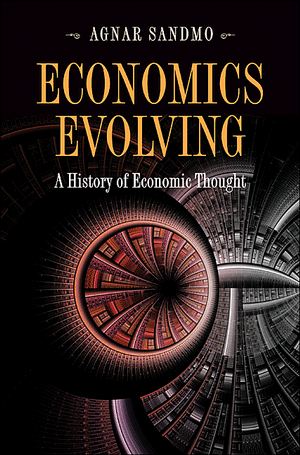
Review - Economics Evolving (Agnar Sandmo)

Following an email exchange with Dan Kuehn and Jon Catalán, I decided that it was finally time to write up a review for Agnar Sandmo's "Economics Evolving" (which I have been punting for some time). Full disclosure is that I know Agnar personally and think that he is a tremendous economist. That said, I started his book before I had actually spoken much to him and honestly believe that I judged it on nothing else but the merits of its content.

And with that, here is the review which I have just posted on Amazon:

...


In his masterful Wealth & Poverty of Nations, economic historian David S. Landes opens with a quip that "Geography has fallen on hard times." I have often wondered whether the same might said of history -- at least when it comes to cataloguing the development of economic thought. Despite the efforts of Landes and co. (who arguably tend to focus more on events rather than thinkers), this subject is sorely absent from the modern economic curriculum.

Agnar Sandmo's excellent Economics Evolving (EE) will hopefully go some way towards remedying that. The book is a compelling history of economic thought, told through the lives and works of the key figures that have shaped the field. The text is lucid and jargon free, so that even complex ideas are conveyed with a clear simplicity. My impression is that any lay person with an interest in economics could pick up the book and gain a deep understanding of the subject. (I personally happened to read EE while doing my graduate studies in economics and it really helped to keep the overarching ideas clear in my head. This can be surprisingly difficult at times, when getting wrapped up in the mathematics or technical arguments of a particular theory might hinder you from seeing the wood for the trees. The concise description of various concepts -- from Walrasian Equilibrium to growth theory -- thus provided a welcome foil to the analytical rigour required by my core grad courses.)

Each chapter or subsection opens with an brief biography of the featured economist(s). These provide valuable context to the overall discussion and are typically interspersed with interesting vignettes and anecdotes. One of my favourites occurs on p. 90, where Sandmo reproduces a letter from John Stuart Mill to the philosopher Jeremy Bentham. The former is enquiring after the 3rd and 4th volumes of Hooke's Roman History, having "recapitulated" the 1st and 2nd volumes. Sandmo points out that this seemingly unremarkable correspondence between two leading intellectuals of the time was actually written when Mill had only just turned six! Mill's almost impossible precocity serves as the ideal backdrop for describing his many later contributions -- in both economics and philosophy -- during the pages that follow.

Sandmo, a fairly eminent economist in his own right, is never less than evenhanded in his discussion of the key figures and thinkers that have shaped the development of economics. His writing is admirably free of ideological bias and I appreciated not being able to necessarily tell which side the author would personally lean to on different economic questions. That is not to say that he is never critical, however, as EE succinctly highlights the faults in many arguments and theories. (E.g. In an interesting chapter on the economic theories of Karl Marx, we are told how a falling rate of profit is a supposedly inevitable feature of capital accumulation, and how this in turn would eventually lead to the entire system collapsing. Sandmo counters (p. 133): "Each element in his chain of reasoning may be criticized", and convincingly proceeds to do exactly that.)

Of course, not everyone's favourite economist can feature prominently (or even at all) in a book that is designed above all to be concise and readable. However, I think it is fair to say that the major players are all covered in admirable depth, as well as numerous others. I particularly enjoyed the sections on the classicists (Malthus, Say, Ricardo, and Mill) and the forerunners to the "Marginal Revolution" (Gossen, Dupuit, Cournot, and Thünen). These are the kinds of tremendously important figures that are normally relegated to the footnotes in most modern economic curricula, and it was refreshing to get a full sense of their contributions and beliefs. I found it intriguing, for instance, to see how well they had often anticipated later developments in the science and continued to have relevant insights for our own economic circumstances of the present day. (It was equally interesting to get a sense of how their views have either been distorted or successfully reproduced by later thinkers.)

In summary, this book is a wonderful companion to any student of economics, and many others besides. I can easily recommend it.

Sunday, January 20, 2013

Review - Extreme Environment (Ivo Vegter)

Extreme Environment (hereafter EE) is a book written by South African journalist, Ivo Vegter. I have mentioned Vegter before on this blog and he generously arranged for me to be sent a free copy of EE after I offered to review it in an online discussion. Given this, and seeing as some of other reviews that I have read are disappointingly superficial, I decided to provide a chapter-by-chapter overview and criticism. I hope that you'll excuse the subsequent length of this post in exchange for some added thoroughness. (If not, a condensed version of this review can be found here.)


The major premise of EE is straightforward: Environmentalists are guilty of making grossly exaggerated claims and the green movement should in general be regarded with extreme scepticism. I fully endorse the more measured observation of the book jacket, which is that we should be just as cautious of the emotive rhetoric of environmentalists, as we are of corporate spin. EE expands on this dictum with varying degrees of success and some parts of the book are undoubtedly more convincing (and fairly presented) than others. It should be said that Vegter is not immune to moments of unfounded hyperbole himself, stating as early on as page 3 that the car could not have been invented in today's world, because it "would never have passed modern safety and environmental rules". (Talk about exaggeration!)

Friday, March 23, 2012

On censorship and misreading Ray Bradbury

Earlier today I read Bill Maher's op-ed in the NYT: Please Stop Apologizing. I deeply agree with his general point and am reminded of the way he put it -- rather more bluntly -- some months ago on his show Real Time: "Stop organizing life around the people who don't get the joke. Fuck them if they don't get [the] joke."

Touché.

Ricky Gervais is often quoted as making the same point, but in a milder form: Just because someone is offended, doesn't make them right.

Going back to Maher's op-ed, I couldn't help but think, as I inevitably do when the topic of censorship comes up, of Ray Bradbury's dystopian classic, Fahrenheit 451. I read the book in high school and my abiding memory -- apart from a great opening quote and the central irony of firemen actually setting fire to things -- has been that it was meant as a warning against the dangers of censorship.

I'm surprised to learn, then, that Bradbury actually disputes this as being the major theme of the book. The Wikipedia page has a decent summary of things and also links to the following video clip from Bradbury's website:


In his own words: "I wasn't worried about freedom, I was worried about people being turned in morons by TV."

The Wiki entry also links to this LA Times article that was written after Bradbury was awarded the 2007 Pulitzer Prize. The following passage caught my eye:
[Bradbury] says the culprit in Fahrenheit 451 is not the state — it is the people. Unlike Orwell’s 1984, in which the government uses television screens to indoctrinate citizens, Bradbury envisioned television as an opiate. In the book, Bradbury refers to televisions as “walls” and its actors as “family,” a truth evident to anyone who has heard a recap of network shows in which a fan refers to the characters by first name, as if they were relatives or friends. 
[snip] 
Bradbury imagined a democratic society whose diverse population turns against books: Whites reject Uncle Tom’s Cabin and blacks disapprove of Little Black Sambo. He imagined not just political correctness, but a society so diverse that all groups were “minorities.” He wrote that at first they condensed the books, stripping out more and more offending passages until ultimately all that remained were footnotes, which hardly anyone read. Only after people stopped reading did the state employ firemen to burn books.
AMUSING UPDATE: Someone should put Bradbury in touch with his publisher. I see that the book is still being billed as "The classic bestseller about censorship" on Amazon. OTOH, why fix something if it ain't broke?

Thursday, March 15, 2012

The face of Gabriel

Jonathan Haid's comments on the spiritual nature of warfare reminded me of a passage in Captain Correli's Mandolin by Louis de Bernières. The character Mandras is something of tragic figure in the book. A simple fisherman who finds himself transformed by the horrors of war and unable to relate to the loved ones that await his return:
Once, near the Metsovon pass, in December, when it was twenty degrees below zero because there was no cloud, the Italians sent up a starshell. It exploded in a cascade of brilliant blue light against the face of the full moon, and the sparks drifted to earth in slow motion like the souls of reluctant angels. As that small magnesium sun hovered and blazed, the black pines stepped out of their modest shadows as though previously they had been veiled like virgins but had now decided to be seen as they are in heaven. The drifts of snow pulsed with the incandescence of the absolute chastity of ice, a mortar coughed disconsolately, and an owl whooped. For the first time in my life I shivered physically from something other than the cold; the world had sloughed away its skin and revealed itself as energy and light. 
It is my wish to get well so that I can go back to the lines and experience, perhaps for only one more time, that immaculate moment when I saw the face of Gabriel in an instrument of war. 
Quite beautiful.

Wednesday, February 1, 2012

Quote of the day - Let it stand

At the beginning of last year, I announced a (mostly) informal book challenge that I'm partaking in. The goal of which is to complete six carefully selected "epics" before my friend and rival literatus, Bloomsboy[*].

Truth to be told, I'm faring pretty disappointingly on that score. Course work and related uni readings have taken over my life. What little spare time I now have is normally spent trolling the internet perusing something a shade lighter and, well, shorter.

My one consolation in all this is that -- according to my sources[**] -- his own progress has been equally unimpressive. Since he allegedly works for a publishing firm, I don't see what his excuse is...

At any rate, it was Bloomsboy who told me a great anecdote not too long ago about one of the five authors in our mandatory set, James Joyce. It concerns his relationship with protégé and Waiting for Godot playwright, Samuel Beckett, at the time when failing eyesight had left him dictating his words to others:
Beckett's mind had a subtlety and strangeness that attracted Joyce as it attracted, in another way, his daughter. [...]Once or twice he dictated a bit of Finnegans Wake to Beckett, though dictation did not work very well for him; in the middle of one such session there was a knock at the door which Beckett didn't hear. Joyce said, `Come in,' and Beckett wrote it down. Afterwards he read back what he had written and Joyce said, `What's that "Come in"?' 'Yes, you said that,' said Beckett. Joyce thought for a moment, then said, `Let it stand.' He was quite willing to accept coincidence as his collaborator.
Richard Ellmann, James Joyce (New York, 1959), pp. 661-662.

In its own small way, the above passage goes some way towards explaining the incomprehensibility of Finnegans Wake... Perhaps making it a bit more palatable at the same time.

---
[*] Self-styled in a moment of apparent irony.
[**] i.e. Bloomsboy.

Friday, December 31, 2010

New Year's Resolutions and Literary snobs

New Year's resolutions? 
Not a fan.

Well, I say that but I'll probably try and harden my resolve in finishing up some things I've been putting off for a while. Speaking of which...

Literary snobs.
I'm probably one.

Okay, okay... Definitely one. I cannot help but snigger loudly into my embroidered handkerchief whenever someone mentions the words "Code" and "Da Vinci" (not necessarily in that order) in any positive context. Similarly, other books will invoke a feeling of disdain even though I've never actually read them and they might even be rather good. (E.g. For some reason or another, Shantaram falls into this category.) It's not something I'm necessarily proud of - or perhaps even justified in feeling - but it's a hard trait to shake nonetheless.

Anyway, I have a competition going with a  friend, Bloomsboy - who I mentioned here and who's quite possibly more snobbish than me - whereby we are meant to read six epic novels. I can't remember exactly where we hit upon the idea, but it was some time while we were traveling through Africa together (which I might write more about later) and comparing the size of our literary dongs. Figuratively speaking, of course. 

The criteria are simple. The chosen books shall be a) Very long, and b) Widely considered as "classics". Our challenge thus involves the following:

1) Anna Karenina - Leo Tolstoy
2) War and Peace - ibid
3) Don Quixote - Cervantes
4) Ulysses - James Joyce
5) Moby-Dick - Herman Melville
6) In Search of Lost Time - Marcel Proust (This was a somewhat late addition to the party and I don't think we've quite decided on how many volumes we're supposed to cover. I'm hoping it's not the whole bloody thing...)

Ingeniously enough, the winner will be decided the old navy way: First guy to die, loses! is simply the person who completes all six first. So far the score is tied at one-one. I'm down War and Peace, while Bloomsboy has got Ulysses under the belt. To be honest, I read W&P some time before our actual bet started. Still, I certainly regard it as one of the best books I've ever read and, as such, I'm looking forward to Anna K. It doesn't hurt that I've yet to hear a bad review of it... Much the same for Don Quixote. I'm less enthusiastic about numbers 4 through 6. Apparently Moby-Dick contains 90-page descriptions of whaling ships... Zzzzzzzzz. 

The aim had been to get them done before I hit the big three zero, but at, uh, current rates that might be a bit on the tight side. (The seven volumes of ISOLT alone come to a million and half words!)

I was wounded to learn that the GF is backing Bloomsboy for this title. True, he is an English major and I'm a lowly economics grad. However, you underestimate my fear of losing!

May the best snob win.
o-[-<

PS - Oh, happy 2011 everyone :)