Wednesday, February 16, 2011

Junk Bond Trader

I'm a little short on time to post anything substantial, but I figure a music post is overdue anyway. And so, with the news that Bernie Madoff has claimed that the certain banks and hedge funds "had to know" of his elaborate ponzi scheme... It seems as good an excuse as any to recall the genius of Elliot Smith:


The imitation picks you up like a habit
Writing in the glow of the TV's static
Taking out the trash to The Man
Give the people something they understand

A stickman flashing a fine-line smile
Junk bond trader trying to sell a sucker a style
Rich man in a poor man's clothes
The permanent installment of the daily dose

And you tell off when you tell it like it is
Your world's no wider than your hatred of his
Checking into a small reality
Boring as a drug you take too regularly

The athelete's laugh, the broken crutch
The first true love that folded at the slightest touch
Brought down like an old hotel
People digging through the rubble for things they can resell

"Happy Holidays," said Sid the Saviour
The leaving lover that I still favor
I won't take your medicine
I don't need a remedy
To be everything I'm supposed to be
I don't want nobody else
I can do it by myself
We're meant to be together

Now I'm a policeman directing traffic
Keeping everything moving, everything static
I'm the hitchhiker you'll recognize passing
On your way to some everlasting

Better sell it while you can

Just remembering how good the lyrics to this song are. Even a direct reference to "Stickman"! The unflattering context aside, I might be tempted to read more into this if only I had more superstitious leanings...

Monday, February 14, 2011

"Our climate isn't the only green concern"

UPDATE: The forest sell-off has been shelved following a massive public outcry.

That's the title of a short article by Michael McCarthy, the environmental editor of The Independent, in which he discusses the apparent flip-flopping of the new UK government on the sale of public forests. In of itself, this is a very interesting issue because it highlights some the practical problems of privatising "public" land. Being of a market persuasion myself, I have nothing much in principal against private ownership of these resources. Indeed, the success of private game parks all over the world gives us an indication of how well that kind of model can work, often in conjunction (and competition) with state-owned parks, to better preserve our natural heritage.

Of course, the UK's forests are perceived quite differently to game parks. They are, I would argue, probably much closer to, say, beaches in the public mindset. For various reasons, public beaches have become institutionalised as places that we like to enjoy in commons. Perhaps people even like the illusion of them being free to everyone regardless of the fact that tax money is what ultimately supports their maintenance. Having said that, there reasons why this system isn't an inherently inefficient; most notably transaction costs and the problems of exclusion. (E.g. It could be much easier for us to make a single payment to one authority that manages these assets on our behalf than to pay a new owner every time you enter a new park or beach. Further, in the absence of unsightly fencing, it is problematic to police who comes in and out, and who has paid for entrance in the first place). At any rate, I think it's fair to say that many public beaches are both well-run and well-policed.

The major point of McCarthy's article that I want to get to, however, is imbedded in his subject line. He gets down to it in the last two paragraphs:
[T]his Government has conflated "the environment" with climate change; the rest is forgotten (at least at the highest level). It was actually in the specific context of global warming policy that Mr Cameron made his "greenest ever" pledge. He saw, rightly, that saving the climate is of overwhelming importance; but he failed to see that there are other green issues, such as the care of the natural world, which are also immensely important and which the public may deem crucial. 
To be fair, being blinded to everything else by climate change is not the fault of this Government only; some of the traditional green pressure groups have followed suit, and Jonathon Porritt, doyen of green activists, pointed out in an angry blog last week how little most of them have done to combat the attack on nature conservation. But the Government will have to wake up to its mistake, or its pledge to be the greenest ever will turn out to be the biggest hostage to fortune of its time in office.
I wholeheartedly agree with this position. As I've written previously:
"I do worry that important non-climate-related research is being sidelined by this overwhelming debate on AGW [Anthropogenic Global Warming]. Clearly, there are some very important scientific and environmental questions unrelated to climate change that deserve research funding as well. Moreover, its really frustrating to see people trying to lump everything under the climate umbrella or ascribe strong climate causation when there isn't any."
THOUGHT FOR THE DAY: Climate change is a hugely important issue for anyone concerned about the environment, say nothing of human welfare. But shoehorning any and every environmental problem into a climate change story does nobody favours. It distracts focus from other genuine environmental issues and only serves to undermine the legitimacy of the climate change movement in the process.

The "call on OPEC"

Reading through some of those Wikileaks' cables from last week on how Saudi Arabia has been... uh... massaging the true extent of their remaining oil reserves, I was reminded of something dubbed the "call on OPEC".

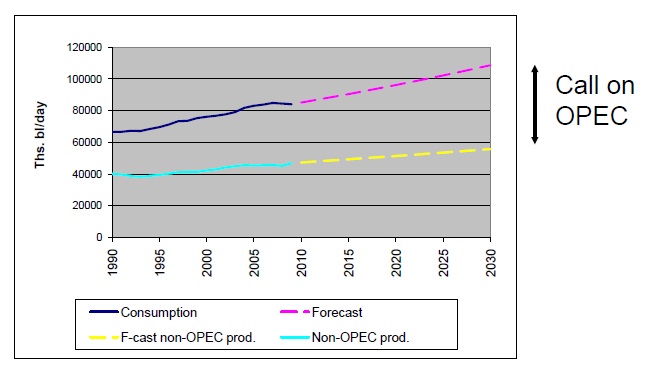
The term was originally coined by the International Energy Agency (IEA) and, essentially, it is a question of whether we can reasonably expect OPEC to make up the (growing) shortfall between future energy demand and the supply coming from other, non-OPEC producers. Or, graphically:

Simple forecasts to 2030 based on average historical growth rates (1990-2009)

Using a very basic forecast as per the above - where the projection is simply an extrapolation of average growth rates since 1990 - we can generate a rough estimate of what the "call" on OPEC will be in 2030. Under these assumptions, OPEC production will have to grow by around 2.3% per year if it is to meet the shortfall in future global energy demand.  Bottom line: OPEC will have to supply an ever-increasing portion of the world's oil.

If you don't care for this simple example, then take OPEC's own word for it, which says that "OPEC will increasingly be called upon to supply the incremental barrel"(pg 10). It also includes the following table:

Adapted from OPEC World Oil Outlook 2010, Pg 71 (Table 1.10)

Taking the above figures as gospel, the implied call on OPEC requires it to increase annual output by 1.8% a year to meet the forecast shortfall in global supply by 2030. Again, the take-home message is that OPEC will almost certainly be expected to supply an increasingly large portion of the world's oil needs.

Is OPEC interested? Is it even capable?

There are various reasons to dispute that they are in either case. For one thing, domestic demand for oil in OPEC member countries continues to rise along with their increasing incomes. Why not keep the oil for themselves? Further, in an environment of rising oil prices, there might be strong incentive to leave reserves in the ground so as to take advantage of higher prices in the future. And now, to really complicate matters, is the possibility that OPEC's principle member, the Kingdom of Saudi Arabia, has been systematically overstating its reserves. It would be remiss of us not to ask whether other members of the cartel have also been overly generous in their estimations of their reserves.

Whatever the case, the world is going to need more fuel than it can easily obtain. Barring some very significant breakthroughs in tar-sand recovery or deep-sea drilling, I wouldn't be putting money on a low oil price any time soon.

UPDATE: Here's an op-ed in the Energy Tribune from September last year that discusses the problems surrounding the "call on OPEC" in more depth. The author, Anas F. Alhajji ("chief economist at Dallas-based NGP Energy Capital Management"), lists five factors that he says will prevent OPEC supplies from meeting the call to global demand. I have already mentioned some of these above (increased domestic demand, leaving reserves in the ground in anticipation of further price increases, etc). He concludes:
The inability to meet the expected “call on OPEC” and the higher prices resulting from shortages will create excellent opportunities for international oil companies, independent producers, and private-equity investors. It will also create an opportunity for other energy sources to fill the gap that OPEC members were expected to fill but did not. 
Indeed, given the expected growth in energy demand in the next two decades, and the possible – even likely – shortfall in OPEC supply relative to the projected “call on OPEC,” the term “alternative energy” will lose its meaning. The only “alternative” to harnessing all feasible energy sources will be a slow-growth world of permanent shortages and increasing misery.

Thursday, February 10, 2011

Wikileaks: Saudis overstating oil reserves

... Apparently by as much as 40%.

Heavy days.

I've yet to read through the actual cables, but The Guardian's summary doesn't paint the prettiest picture:
The US fears that Saudi Arabia, the world's largest crude oil exporter, may not have enough reserves to prevent oil prices escalating, confidential cables from its embassy in Riyadh show. 
The cables, released by WikiLeaks, urge Washington to take seriously a warning from a senior Saudi government oil executive that the kingdom's crude oil reserves may have been overstated by as much as 300bn barrels – nearly 40%. 
[snip] 
According to the cables, which date between 2007-09, Husseini [a geologist and former head of exploration at the Saudi oil monopoly Aramco] said Saudi Arabia might reach an output of 12m barrels a day in 10 years but before then – possibly as early as 2012 – global oil production would have hit its highest point. This crunch point is known as "peak oil". 
Husseini said that at that point Aramco would not be able to stop the rise of global oil prices because the Saudi energy industry had overstated its recoverable reserves to spur foreign investment. He argued that Aramco had badly underestimated the time needed to bring new oil on tap. 
Nothing is fucked here, Dude
Intriguing times, indeed.

UPDATE: A more cornucopian take on this whole saga from Michael C. Lynch here. Although, it would be remiss of me not to show you this Forbes article from 2006, where Lynch was confidently predicting that oil prices would dip to $20/bbl by 2008...

Two quick links - Krugman edition

Paul Krugman is the ultimate polarising force. People either love him or loathe him. I suppose that's what comes with the territory when you are, arguably, the world's most high profile economist.

Anyway, seeing as I referred to him in my previous posts on climate change and food prices, here are two links that seem kinda relevant.

1) Roger Pielke Jr has a post criticizing Paul Krugman's citiation of extreme weather events in which he questions any causation between long-run carbon levels and food prices. I left a comment saying, among other things, that I regard his invocation of the historical food record as tempting the gods of false equivalence. I also think that he's being uncharitable in his basic reading of Krugman's argument. Still, it's an interesting debate with thought-provoking points raised on both sides... I'd especially like to see whether more people pick up on my comments about Norman Borlaug and the possibilities of another "Green Revolution".

2) Back to PK himself, who, in commenting on the American Economic Review's "Top 20" papers of the last 100 years, had this to say:
It’s also worth noting that a number of the papers on the list involve very simple, intuitive models — that includes Friedman on the natural rate, Krueger on rent-seeking, Mundell on currency areas; Shiller’s great piece on stock volatility was also a remarkably simple concept yielding a powerful insight. My own paper was actually pretty math-heavy; uncharacteristically, it’s also a paper in which doing the math fundamentally changed my mind about things (I didn’t believe the home market effect was real until it popped out of the equations; only then did I realize it was obvious.)
Hmmm. Sounds kinda familiar...
Further, and I would say more importantly, [maths] enables us to fully work through the consequences and dynamics of [economic] relationships. Our intuition may suggest certain outcomes, but intuition can be pretty limited in scope. Working through a set of equations enables you to arrive at a final result with a cool clarity, which may then show up unexpected results that only become “intuitive” upon further reflection.
;)

o-[-<

Wednesday, February 9, 2011

Discount rates, relative prices and climate economics

Yesterday I wrote a bit about the "relative prices" argument for swift and decisive action against climate change. Some additional comments to provide context:

For economists engaged in the climate change debate, one of the most important – yet difficult – things to find agreement on is a suitable discount rate. This may seem a strange issue to fixate on from the perspective of non-economists, but the point here is that climate change is an intergenerational problem that will potentially affect many people over time. The question then is how to measure future costs and benefits against those of the present?

As with any investment which involves cost-benefit analysis over time, the favoured approach in climate change economics is to use a discount rate.[*] This allows us to assess things in present value (PV) terms. Thus, and while it may seem somewhat trivial against the wider scientific uncertainties of climate change, the discount rate actually proves a critical factor in determining the economically efficient level of abatement. Here's a simple example to illustrate the importance of choosing a particular rate of discount:
If we discount \$100 a hundred years from now at a rate of 1 percent, we obtain a present value of around \$37. However, if we feel slightly more impatient and raise the discount rate to 3 percent, then the present value falls to only \$5!
Importantly, the effect of compound interest means means that we see an exponential impact from the difference in discount rates, as well as the length of time that we are discounting. In other words, we're dealing with a distinctly non-linear process.The central message to take away is that – when it comes to estimating economic costs and benefits of the future – seemingly innocuous changes in your a priori assumptions over the discount rate can lead to substantial differences in cumulative terms. (Use this calculator to see for yourself.)

So, the choice of discount rate has a potentially massive impact on the perceived efficiency and timing of climate policy. Again, it is worth emphasising the intergenerational nature of climate change, where present (and future) sacrifices will have to be made in order to protect future incomes and utilities. The corollary of this is that acting too slowly may harm future generations in the form of rising climate costs, whilst acting too quickly may be equally as harmful by unnecessarily limiting economic growth.

Against this background, it probably won't be surprising to hear that the chief criticisms for the much-feted Stern Review –  from an economics perspective at least –  were reserved for his choice of discount rate. By drawing on the famous Ramsey Equation[**], Stern used largely ethical arguments in deriving a final discount rate of 1.4%. This, his critics argued, was much too low in comparison with observed market rates, which are closer to 3-4%. Moreover, since Stern's major findings hang on a "low" discount rate, the same critics say that his central policy recommendation of "act fast, act now" does not hold. (Indeed, a belief in higher discount rates is what underpins a lot of economic rationalisation on the benefits of delayed action against climate change; e.g. focus on growing our economies as fast as possible now so that we will be in a better, wealthier position to deal with the effects of climate change in the future.)

At the same time, however, numerous other economists have come out strongly in support of Stern, while he also has vigorously defended his methodology in the period since. In the interest of keeping this post as short as possible, I won't go into much further detail on this debate between supporters of Stern and their opponents (or those in between). I highly encourage you to look over the Sterner and Persson paper that I recommended previously for a very readable summary of the various elements involved in determining the discount rate, as well as the different schools of thought on what the appropriate level really is.

What I did want to get to today was this: One of the most interesting insights of the "relative prices" argument from my perspective is that strong, early emissions reductions can be economically justified even in the presence of high discount rates. Prior to this, opponents to early abatement paths such as those proposed by Stern have argued that such plans can only be sustained in the presence of what they perceive to be unacceptably/unrealistically low discount rates. And yet, we now see compelling economic reasons to follow an aggressive emissions path even when using high rates of interest.[***]

In other words, the relative price argument allows us to partly abstract from the intrinsic subjectivity of the discount debate, which currently clouds the timing of climate policy. It does this by demonstrating the extent to which a loss in natural assets (clean water, predictable seasons, etc) could affect our ability to generate, or even enjoy, man-made assets (such as cars, computers, restaurants and so on) in the future. In this way, we are able to formalise the intuitive concerns that many people have regarding the destabilisation of natural systems that we are intimately dependent on.

THOUGHT FOR THE DAY: The choice of discount rate is crucial to determining an "economically efficient" response to climate change. Unfortunately, there is widespread disagreement among economists as to what the correct discount rate is. However, by incorporating the impact of relative prices into our analysis, we can still conclude that it is better to act sooner, rather than later... even if we assume a discount rate that is relatively high. And that is a critical first step to reach agreement on.

-----
[*] There are people who question the validity of even using the "standard" cost-benefit analysis (CBA) approach to climate change, but that remains another subject for another day.

[**] The Ramsey Rule is: r = δ + η * g 
        Which says that the discount rate (r), is equal to the sum of the pure rate of time preference (δ) and the product of the elasticity of the marginal utility for money (η) and the per capita growth rate of the economy (g). To simplify, we interpret the first component of the equation, δ, as the tendency to discount future utility simply because it is in the future. The second component, η * g, implies that we value future consumption less than consumption today, because our wealth should increase over time as the result of economic growth. This latter notion rests on the assumption that a rich person gains less welfare than a poor person for a given quantity of money.

[***] This is a bit of a simplification. The choice of discount rate will always have an impact on how aggressively we approach the issue of climate change. However, we are left with a central message that – regardless of differing opinions on what the discount rate should be – it is still in humanity’s best interest to decisively cut emissions sooner rather than later.

Monday, February 7, 2011

Food prices and climate change (gasp!)

Secondary subject line: The relative prices argument for strong action against climate change.

Paul Krugman must have been feeling more provocative than usual yesterday:
What’s behind the surge in food prices? The usual suspects have made the usual claims — it’s all about the Fed, or it’s all about speculators. But I’ve been looking at the USDA World supply and demand estimates, and what stands out from the data is mainly that we’ve had a huge global harvest failure. 
[snip]
Why is production down? Most of the decline in world wheat production, and about half of the total decline in grain production, has taken place in the former Soviet Union — mainly Russia, Ukraine, and Kazakhstan. And we know what that’s about: an incredible unprecedented heat wave. 
Despite his later disclaimer about attributing any single weather event to larger trends in our climate, you have to credit Krugman for knowing how to rile the opposition. The implication that rising food prices (i.e. inflation) are the result of climate change -- rather than the actions of Dark Lord Ben Bernanke and his evil minions -- is enough to have caused brain explosions in conservative households across America. The only way that Krugman could have come up with a more unholy combination aimed at upsetting this particular constituency would be to suggest that Mao Zedong was directly descended from Jesus.

Anyhoo, I don't wish to get dragged into the relative merits of Krugman's argument on what is causing the current rise in food prices.[*] What I am interested in, however, is the idea that he touches on here; how climate change could affect food prices. It got me thinking about one of the strongest arguments I have heard in favour of swift and decisive action against climate change: the role of relative prices.

The basic gist of the relative prices argument goes like this: Environmental goods and man-made goods are imperfect substitutes. With environmental goods expected to become "scarcer" as a result of climate change (increased drought, loss of biodiversity, etc), it follows that they will become more expensive in comparison with man-made goods. This will clearly impact our ability to generate future wealth and needs to be accounted for when we evaluate our best response to climate change. Indeed, incorporating this into our analysis strongly supports the notion that we should be looking at decisive action against climate change sooner rather than later.

The above ideas are neatly encapsulated in the following paper by Sterner and Persson: An Even Sterner Review - Introducing Relative Prices into the Discounting Debate. As I have said elsewhere, this might be the one paper that I would recommend everyone read to understand the basic arguments surrounding the economics of climate change. The authors do a great job in discussing the most salient aspects of the discount rate (which is central to much of what climate change economics is about) and the controversy surrounding different estimates by the likes of the Stern Review and his opponents, before adding their own contribution via the aforementioned relative prices twist. Seriously, have a look. It's not too long and very readable.[**] 

Anyway, I was thinking of all this when I read that Krugman post. I left a comment -- lost among the many :'( -- that included a quote from the above Sterner and Persson paper, which is very germane to the issue at hand:
"[G]lobal agriculture is said to represent 24 percent of global GDP (Stern Review, p. 67). A 1-percent loss of agricultural output might be estimated to reduce global GDP by.24 percent. Basic logic, however, tells us that a 50-percent loss of agricultural production would reduce global GDP by much more than 12 percent, and a 100-percent loss would reduce GDP by more than 24 percent of GDP. The mechanism behind this would be escalating food prices: As food became more and more scarce, its relative price would rise so fast that the dwindling food supplies would crowd out everything else and approach 100 percent of total GDP." (Pg. 68, emphasis added)
THOUGHT FOR THE DAY: Apart from being tremendously self-indulgent, one of the reasons I started this blog was because I wanted to try and act as an intermediary for ideas that I have come across in my field of specialisation (environmental and natural resource economics) and put them in a format that friends and non-specialists could easily access and debate. When it comes to the economics of climate change, reasonable people have argued that it makes sense to focus adaptation measures rather than attempting to reduce carbon output. Typically, this would involve the continued heavy use of fossil fuels in a bid to grow our economies as fast as possible so as put us in a better position to deal with any effects that climate change has. However, there are several reasons why I respectfully, yet firmly, disagree with this position. The impact that relative prices will have on our ability to create wealth is chief amongst these.

UPDATE: I have some follow-up comments about this relative prices issue, as well as the role of the discount rate in climate change economics here. 
___
[*] For what it's worth, I think that we are going to see higher food prices generally in comparison to previous decades. In particular, the evidence points to a stronger link between the prices of energy and non-energy goods. This was a key driving factor during the 2006-2008 boom and, while the recession may have burst that particular bubble, I don't see any obvious reason why the fundamentals have changed. 

[**] For those of you feeling up to it, the ever-impressive Christian Gollier has put forward a number of analogous, though far more technical papers on this subject... For example here and here. [Wonkish: By focusing on the "ecological discount rate", Gollier actually goes some way to merging the relative price argument with Weitzman’s uncertainty principal, before arriving at separate discount rates for biodiversity (1.5%) and consumption (3.2%). As some of you may recognise, the former is pretty much on par with Stern’s rate of 1.4%…]

Dumb regulation

As should be clear from some of my previous posts, I think that some areas of our economy are in need of regulation; others distinctly less so. Here is an article describing some cases that fall into the latter category: A License to Shampoo: Jobs Needing State Approval Rise

Apart from the more ridiculous stories of occupational licensing, perhaps the most interesting insight is that the call for more regulation is coming from the practitioners themselves. They argue that "regulation will boost the prestige of their professions, provide oversight and protect consumers from shoddy work." Of course, the cynical economist in me says it would be remiss of us not to highlight problems of rent-seeking. Still, this is an admirably balanced article and not simply an anti-Government rant. 

A quote I rather enjoyed:
Mr. Lykins says it's in the public's interest to insist manicurists are well-trained. "Have you ever had a nail fungus? It's terrible," he says. "That's why we're there."
[Snaps fingers, bobs head]


===

I've also been meaning to describe a particularly daft case of regulation that I've come across here in Lisbon. Across the city there are many decrepit and abandoned buildings, literally right in between thriving office blocks. This was really puzzling to me at first as, Portugal's wider economic troubles notwithstanding, I couldn't understand how you could get such variation within the same neighbourhoods... even the richest parts of the city are afflicted. From asking my Portuguese friends there are various reasons for this problem, including a rush out to Lisbon's outer suburbs that left the central parts of city suddenly much emptier than they had ever been. However, here is aspect worth retelling as cautionary note for all would-be rent controllers: 

(The precise details may be a little off here, but not so much that it materially affects the story.)

After the Carnation Revolution in 1974 overthrew the authoritarian Esta Nova regime created by Antonio Salazar, the left-leaning revolutionaries instilled a new law whereby property rent was fixed from the time that a person first moved in. Tenants may have celebrated this ruling at first, but of course this also meant that landlords had no incentive to invest in maintaining or renovating their buildings over the years that followed. I believe the law has since been amended to allow for rent increases in line with inflation, but long-established tenants (particularly in the south of the city) are still paying absurdly low rentals. This includes historic neighbourhoods like the otherwise beautiful Alfama... even buildings that would constitute prime real estate right in the financial district.

The same tenants that benefited from decades of low rentals now have to live in dangerously decrepit buildings. Worse, there is a very real social problem at stake, since the housing "shortage" has pushed up prices for residents in functioning buildings all over the city. As with abandoned neighbourhoods around the world, there is a lingering problem of crime in places where no-one is investing and actively living. 

[UPDATE: Here is an article discussing the same problems behind  the abandoned buildings of Lisbon. Here's another.]

THOUGHT FOR THE DAY: Dumb regulation will make everyone's lives worse off, no matter how good the underlying intentions.

Saturday, February 5, 2011

Torres on football clubs: "Romance is dead"

[HAPPY UPDATE: Well, well, well... What do you know? Perhaps romance isn't dead! Headline this morning: Torres endures nightmare debut as Liverpool regain old swagger. As John said to Paul:

]

I'm a rugby man first and foremost, but have certainly grown into my football fandom over the last few years... especially after spending time in England and other parts of Europe. You cannot help but get up to speed on your weekend football results and banter if you properly want to integrate into a London, Oslo, or Lisbon. (On that note, I'm always struck by how much of leveller sport is around the office, which is one of the great things about it. I've seen canteen staff vigorously debating top management types on something as mundane as an offside play from the weekend more times than I care to remember...)

And, of course, the World Cup in South Africa was, to use the local vernacular, ama-ZING. I only went to one stadium game*, but was right in the heart of the action for most of the tournament. The fanwalk area around Cape Town Stadium was always epic, as was the general vibe in the whole country at the time. I'm really stoked that I got the chance to go back for that.

Anyway, what I'm getting to here is an article from The Independent on a Fernando Torres press conference, following his much-discussed (read: highly controversial) transfer from Liverpool to Chelsea. I should add that Liverpool happen to be, unfortunately, my club of choice and this has been a tough gig the last few seasons. Torres was, for the most part, the highpoint for any Liverpool supporter during this period:
Romance is dead, says £50m Torres
Fernando Torres dismissed accusations of disloyalty over his controversial move from Liverpool to Chelsea yesterday by declaring that "romance is dead" in football when it comes to players sticking with their clubs and said he did not have the time to wait for Liverpool to rebuild.
In a frank and revealing press briefing, Torres said that he simply ran out of patience with Liverpool and feared that he would miss out on collecting the domestic trophies that so many of his Spain World Cup-winning team-mates have. He denied the allegations of hypocrisy over his previous protestations of loyalty to Liverpool by claiming that the only club he really loved was his childhood side, Atletico Madrid.
[snip]
With the likelihood that he will start, Torres said that he would not celebrate if he scored against his former side but that was the only concession to sentimentality he made. He disagreed with accusations that he was a traitor, saying that he had given Liverpool three and a half good seasons as well as generating the club a major profit.
Torres said: "I see some players doing that [kissing the badge] when they join a club, but the romance in football has gone. It's a different thing now. People [players] are coming and leaving. When you are joining a club you want to do the best for yourself and that club, and that's all. Some people like to kiss the badge. They can do it. I only want to score goals and do my job, and achieve all the targets the team has.
"I took the decision to leave Liverpool because I heard about Chelsea's interest. They were pushing hard, which means they really wanted me. I really wanted to leave Liverpool, so I told them straight. Everything was clear. At the end of the day, it's about being fair and honest with everyone."
I have to agree with him. For all the talk about loyalty, professional sport is a completely different animal from days gone by. Liverpool ceded the moral high ground some time ago when they embraced the same foreign-owner, foreign-player, high stakes financial game as everyone else. I'm not saying they could have avoided it - indeed, that's largely my point and if those are the rules of the road, you best stick to them. This post isn't meant to be a glowing review of the way Roman Ambramovich runs Chelsea (far from it), but football has made its own bed and now it's time to sleep in it.**

The top players expect to be surrounded by peers and management of similar calibre. If Liverpool couldn't provide that to a guy like Torres (indeed, they dismissed some of their best players in the last two seasons), what rights do they think they have in playing the loyalty card?

THOUGHT FOR THE DAY: The surest way to get someone to act like clown is to start treating them like they're in circus. Those who don't buy into the show can - and probably will - leave.

* If you're interested, the game in question was France-Uruguay. The game itself was rubbish (a nil-nil draw), but it took place on the opening day directly after Bafana Bafana (the SA national side) played Mexico in the first game of the tournament in Johannesburg. I went with a few mates and, having already spent a good few hours in the pub, we were fairly steamrolled by the time of the Cape Town kick-off. Not only that, but for some reason we had decided to go as three gorillas and a banana... Okay, the reason being we wanted to boost our chances of media footage! It worked a charm though; here's a pic from the next day's paper that was taken of of us (alongside some girls supporting ze frogs) taken just prior to the game:


** Sometimes I truly think that the salary caps in rugby (in places such as England) are a good thing. It seems inevitable to me that football will blow up in ever-expanding bubble of unsustainable salaries and dangerously debt-financed clubs. In a related note, here is the ever-provocative Bill Maher on what "makes NFL football so great" (spoiler: "socialism"): Irritable Bowl Syndrome. If you can't watch the clip, here is a text version.

Thursday, February 3, 2011

Karl Smith on the importance of maths-free papers

... And simple allegorical stories to help our intuitive understanding of economic concepts. Here is an excerpt:
I posted a link to Bryan Caplan’s paper on Behavioral Economics and the Welfare State. Many of the comments I got from economists were predictable:  
   1. Where is the formal model and existence proofs?
   2. Where is the data analysis?
   3. How is this a paper?
   4. Do you mean to tell me this is publishable? 
I too was shocked initially by these features or lack thereof. However, that’s part of what made the paper compelling.
Some papers get a wonderful data set, perform magnificent identification and get a result that really changes your mind about something you care about. Most don’t.
Most are cases that are of very narrow interest or do a 90% good job at the ID but leave enough doors open that you are not really sure if  the result is meaningful or not.
On the other hand, one could as Bryan and his co-author did, attack an important question, string together some non-obvious points and in my case leave the reader thinking about whether he or she should reexamine an import view.
The profession should rightly celebrate the first kind of paper. However, what about the relative worth of the second and the third?
I submit that bringing up arguments that use the economic way of thinking matter. This is true even if the argument is not definitive, has no mathematical proof behind it and marshals no data.
Now, clearly I've written in support of using maths in economics on this blog before. However, in case anyone missed it, my point was not to say that we have to have put forward a mathematical equation for each and every economic argument or study. Indeed, I took some pains to make it explicit that this wasn't the case... Shoehorning a maths proof into an economics paper does not (cannot) constitute analytical rigour, let alone intellectual honesty.

I wholeheartedly agree with the excerpt above. We should embrace any economic paper and/or argument that aids our conceptual understanding, or forces us to re-examine our views on a particular subject. However, I continue to submit that theory alone is insufficient... 

Smith goes on to describe the baby-sitting coop allegory, which he says did more to make him a "confident Keynesian" than any other analysis. The important caveat here is that - as pointed out in the comments section - we have competing parables such as Bastiat's "Broken Window" that appear to offer completely different policy prescriptions. Again, this reinforces my belief that we ultimately need to seek empirical validation/refutation of our theories, whether they come in the form of a complex mathematical proof or a simple children's story. As I wrote here:
Knowing when to use your tools is just as important as knowing how to use them. Also, the ultimate test for any model - mathematical or otherwise - should always be how well it describes real-life data.
THOUGHT FOR THE DAY: It's always good to have a explanation at hand that everyone can understand.


PS - The Bryan Caplan paper that Smith is making reference to here is well worth a read. There are also some interesting critiques in the comments section of Smith's initial post about it.