If for no other reason than my apartment gets some camera time.[*]
Some very mellow Sunday night listening with suitably serene Scandinavian scenes.
[*] I'm basically famous now.

Sunday, February 12, 2012


Friday, February 10, 2012
Science and distortion
Below is a video of the late climate scientist, Stephen Schneider. Please watch it and tell me that scientists are the ones trying to polarize this debate and selectively feed us alarmist harbingers of doom. Specifically note Schneider's comment at the 3:35 mark on the false dichotomies, "end of the world" and "good for you".
I see (environmental) economists as making meaningful contributions to this project as well. Cutting through the extreme and distortionist views, so that we can finally settle on some sensible solutions. At times that seems too much to hope for, but every skeptic could do with an optimistic streak...
UPDATE: From 6:04, Schneider provides a great summary of the role that risk management plays in this whole climate debate. I'd refer readers to this post, where I make very similar observations on risk probabilities and insurance decisions.
I see (environmental) economists as making meaningful contributions to this project as well. Cutting through the extreme and distortionist views, so that we can finally settle on some sensible solutions. At times that seems too much to hope for, but every skeptic could do with an optimistic streak...
UPDATE: From 6:04, Schneider provides a great summary of the role that risk management plays in this whole climate debate. I'd refer readers to this post, where I make very similar observations on risk probabilities and insurance decisions.
Wednesday, February 1, 2012
Quote of the day - Let it stand
At the beginning of last year, I announced a (mostly) informal book challenge that I'm partaking in. The goal of which is to complete six carefully selected "epics" before my friend and rival literatus, Bloomsboy[*].
Truth to be told, I'm faring pretty disappointingly on that score. Course work and related uni readings have taken over my life. What little spare time I now have is normally spenttrolling the internet perusing something a shade lighter and, well, shorter.
My one consolation in all this is that -- according to my sources[**] -- his own progress has been equally unimpressive. Since he allegedly works for a publishing firm, I don't see what his excuse is...
At any rate, it was Bloomsboy who told me a great anecdote not too long ago about one of the five authors in our mandatory set, James Joyce. It concerns his relationship with protégé and Waiting for Godot playwright, Samuel Beckett, at the time when failing eyesight had left him dictating his words to others:
In its own small way, the above passage goes some way towards explaining the incomprehensibility of Finnegans Wake... Perhaps making it a bit more palatable at the same time.
[**] i.e. Bloomsboy.
Truth to be told, I'm faring pretty disappointingly on that score. Course work and related uni readings have taken over my life. What little spare time I now have is normally spent
My one consolation in all this is that -- according to my sources[**] -- his own progress has been equally unimpressive. Since he allegedly works for a publishing firm, I don't see what his excuse is...
At any rate, it was Bloomsboy who told me a great anecdote not too long ago about one of the five authors in our mandatory set, James Joyce. It concerns his relationship with protégé and Waiting for Godot playwright, Samuel Beckett, at the time when failing eyesight had left him dictating his words to others:
Beckett's mind had a subtlety and strangeness that attracted Joyce as it attracted, in another way, his daughter. [...]Once or twice he dictated a bit of Finnegans Wake to Beckett, though dictation did not work very well for him; in the middle of one such session there was a knock at the door which Beckett didn't hear. Joyce said, `Come in,' and Beckett wrote it down. Afterwards he read back what he had written and Joyce said, `What's that "Come in"?' 'Yes, you said that,' said Beckett. Joyce thought for a moment, then said, `Let it stand.' He was quite willing to accept coincidence as his collaborator.
Richard Ellmann, James Joyce (New York, 1959), pp. 661-662.
In its own small way, the above passage goes some way towards explaining the incomprehensibility of Finnegans Wake... Perhaps making it a bit more palatable at the same time.
---
[*] Self-styled in a moment of apparent irony.[**] i.e. Bloomsboy.
Tuesday, January 31, 2012
The best blog post that I've read so far in 2012...
... is really a reprint of this 1865 letter from an ex-slave to his old master. I'll let Letters of Note take it away:

In August of 1865, a Colonel P.H. Anderson of Big Spring, Tennessee, wrote to his former slave, Jourdan Anderson, and requested that he come back to work on his farm. Jourdan — who, since being emancipated, had moved to Ohio, found paid work, and was now supporting his family — responded spectacularly by way of the letter seen below (a letter which, according to newspapers at the time, he dictated).
Rather than quote the numerous highlights in this letter, I'll simply leave you to enjoy it. Do make sure you read to the end.
(Source: The Freedmen's Book; Image: A group of escaped slaves in Virginia in 1862, courtesy of the Library of Congress.)
Given some of the reignited debates over the American Civil War and Abraham Lincoln's legacy that we've been exposed to recently, I find this a wonderfully serendipitous discovery. Beyond the simple matter of timing, it's contents serve to show up some contrarian notions of slave-owner compensation with an wistful humour and stark clarity that even Ta-Nehisi Coates can only envy.
HT: Michael Clemens
In August of 1865, a Colonel P.H. Anderson of Big Spring, Tennessee, wrote to his former slave, Jourdan Anderson, and requested that he come back to work on his farm. Jourdan — who, since being emancipated, had moved to Ohio, found paid work, and was now supporting his family — responded spectacularly by way of the letter seen below (a letter which, according to newspapers at the time, he dictated).
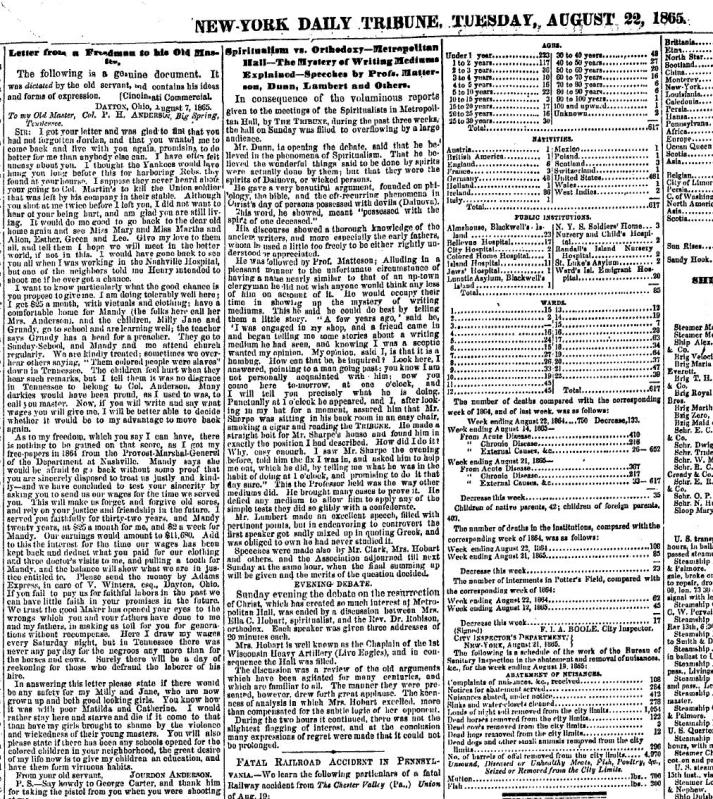
Rather than quote the numerous highlights in this letter, I'll simply leave you to enjoy it. Do make sure you read to the end.
(Source: The Freedmen's Book; Image: A group of escaped slaves in Virginia in 1862, courtesy of the Library of Congress.)
Dayton, Ohio,
August 7, 1865
To My Old Master, Colonel P.H. Anderson, Big Spring, Tennessee
Sir: I got your letter, and was glad to find that you had not forgotten Jourdon, and that you wanted me to come back and live with you again, promising to do better for me than anybody else can. I have often felt uneasy about you. I thought the Yankees would have hung you long before this, for harboring Rebs they found at your house. I suppose they never heard about your going to Colonel Martin's to kill the Union soldier that was left by his company in their stable. Although you shot at me twice before I left you, I did not want to hear of your being hurt, and am glad you are still living. It would do me good to go back to the dear old home again, and see Miss Mary and Miss Martha and Allen, Esther, Green, and Lee. Give my love to them all, and tell them I hope we will meet in the better world, if not in this. I would have gone back to see you all when I was working in the Nashville Hospital, but one of the neighbors told me that Henry intended to shoot me if he ever got a chance.
I want to know particularly what the good chance is you propose to give me. I am doing tolerably well here. I get twenty-five dollars a month, with victuals and clothing; have a comfortable home for Mandy,—the folks call her Mrs. Anderson,—and the children—Milly, Jane, and Grundy—go to school and are learning well. The teacher says Grundy has a head for a preacher. They go to Sunday school, and Mandy and me attend church regularly. We are kindly treated. Sometimes we overhear others saying, "Them colored people were slaves" down in Tennessee. The children feel hurt when they hear such remarks; but I tell them it was no disgrace in Tennessee to belong to Colonel Anderson. Many darkeys would have been proud, as I used to be, to call you master. Now if you will write and say what wages you will give me, I will be better able to decide whether it would be to my advantage to move back again.
As to my freedom, which you say I can have, there is nothing to be gained on that score, as I got my free papers in 1864 from the Provost-Marshal-General of the Department of Nashville. Mandy says she would be afraid to go back without some proof that you were disposed to treat us justly and kindly; and we have concluded to test your sincerity by asking you to send us our wages for the time we served you. This will make us forget and forgive old scores, and rely on your justice and friendship in the future. I served you faithfully for thirty-two years, and Mandy twenty years. At twenty-five dollars a month for me, and two dollars a week for Mandy, our earnings would amount to eleven thousand six hundred and eighty dollars. Add to this the interest for the time our wages have been kept back, and deduct what you paid for our clothing, and three doctor's visits to me, and pulling a tooth for Mandy, and the balance will show what we are in justice entitled to. Please send the money by Adams's Express, in care of V. Winters, Esq., Dayton, Ohio. If you fail to pay us for faithful labors in the past, we can have little faith in your promises in the future. We trust the good Maker has opened your eyes to the wrongs which you and your fathers have done to me and my fathers, in making us toil for you for generations without recompense. Here I draw my wages every Saturday night; but in Tennessee there was never any pay-day for the negroes any more than for the horses and cows. Surely there will be a day of reckoning for those who defraud the laborer of his hire.
In answering this letter, please state if there would be any safety for my Milly and Jane, who are now grown up, and both good-looking girls. You know how it was with poor Matilda and Catherine. I would rather stay here and starve—and die, if it come to that—than have my girls brought to shame by the violence and wickedness of their young masters. You will also please state if there has been any schools opened for the colored children in your neighborhood. The great desire of my life now is to give my children an education, and have them form virtuous habits.
Say howdy to George Carter, and thank him for taking the pistol from you when you were shooting at me.
From your old servant,
Jourdon Anderson.
Given some of the reignited debates over the American Civil War and Abraham Lincoln's legacy that we've been exposed to recently, I find this a wonderfully serendipitous discovery. Beyond the simple matter of timing, it's contents serve to show up some contrarian notions of slave-owner compensation with an wistful humour and stark clarity that even Ta-Nehisi Coates can only envy.
HT: Michael Clemens
Sunday, January 29, 2012
Cardinal sins
The French statesman Charles Talleyrand famously lamented of the Bourbons: "They have learned nothing and forgotten nothing."
For a modern (if less grandiose) parallel, we have this curious insistence by many Austrians that mainstream economists cling to a flawed concept of cardinal -- rather than ordinal -- utility.[*] To this, the mainstream economists respond: "Huh?"
UPDATE: More of the same here.
UPDATE 2: Daniel Kuehn gives us the in-depth treatment here.
[*] No doubt the eyes of my non-economist readers have already glazed over, but the difference between the two concepts is explained here. In brief, cardinal utility refers to a utility level that can be precisely measured and compared in common units. While useful for teaching purposes, needless to say this is pretty unrealistic; let alone measurable. (E.g. An ice-creams is 1.5 times as good as a chocolate bar, and 2.5 times better than a hamburger.) Ordinal utility, on the other hand, simply allows you to rank the utility that you get from these different goods. (My favourite foods in order of preference are: 1) ice-cream, 2) chocolate and 3) hamburgers.)
 |
| Charles Maurice de Talleyrand-Périgord Diplomat. Fan of cravats. |
For a modern (if less grandiose) parallel, we have this curious insistence by many Austrians that mainstream economists cling to a flawed concept of cardinal -- rather than ordinal -- utility.[*] To this, the mainstream economists respond: "Huh?"
UPDATE: More of the same here.
UPDATE 2: Daniel Kuehn gives us the in-depth treatment here.
[*] No doubt the eyes of my non-economist readers have already glazed over, but the difference between the two concepts is explained here. In brief, cardinal utility refers to a utility level that can be precisely measured and compared in common units. While useful for teaching purposes, needless to say this is pretty unrealistic; let alone measurable. (E.g. An ice-creams is 1.5 times as good as a chocolate bar, and 2.5 times better than a hamburger.) Ordinal utility, on the other hand, simply allows you to rank the utility that you get from these different goods. (My favourite foods in order of preference are: 1) ice-cream, 2) chocolate and 3) hamburgers.)
Sunday, January 15, 2012
Quote of the day - A priori reasoning
"The a priori reasoning is so entirely satisfactory to me that if the facts won't fit in, why so much the worse for the facts."
- Erasmus Darwin, writing to his brother Charles upon reading the Origin of Species in 1859.
 |
| Erasmus Darwin |
Then, to temper things somewhat, read this wonderful little essay[*] by Nicholas Humphrey on why we should still be suspicious whenever an elegant explanation comes our way, much as our brains want us to believe.
___
[*] Part of a most interesting collection of responses to the question: "What is your favourite deep, elegant or beautiful explanation?" Other respondents include Richard Dawkins ("Redundancy Reduction and Pattern Recognition"), Richard Thaler ("Commitment"), Steven Pinker ("Evolutionary Genetics Explains The Conflicts of Human Social Life") and many, many others.
___
[*] Part of a most interesting collection of responses to the question: "What is your favourite deep, elegant or beautiful explanation?" Other respondents include Richard Dawkins ("Redundancy Reduction and Pattern Recognition"), Richard Thaler ("Commitment"), Steven Pinker ("Evolutionary Genetics Explains The Conflicts of Human Social Life") and many, many others.
The Meters - Ain't No use
Because it's Sunday and you deserve it.
Tragically unappreciated by the public at large. Spread the funky word..
Tragically unappreciated by the public at large. Spread the funky word..
Monday, January 9, 2012
Walk Off The Earth - "Somebody that I used to know"
It may not be Thursday and the opening guitar riff is uncannily reminiscent of Baa Baa Black Sheep, but this is one of coolest covers I've heard/seen in ages.
.
.
Friday, January 6, 2012
Low-cost lighting from used plastic bottles
As a general rule, bottled water is not particularly good for the environment. If I were the judgmental type, I might even chime in that buying bottled water is pretty dumb -- at least in the circles that I move in -- given that it is typically of no better quality than tap water. But each to their own.[*]
Regardless, this is very cool:
(via WIMP)
UPDATE: The GF points out that I perhaps shouldn't emphasise the bottled water angle so much, since any beverage bottle would do (fizzy drinks, etc).
[*] Okay, I'm being a bit facetious here. I actually agree with David Zetland that bottled water is probably best viewed as a consumer product much like any other.
Regardless, this is very cool:
UPDATE: The GF points out that I perhaps shouldn't emphasise the bottled water angle so much, since any beverage bottle would do (fizzy drinks, etc).
[*] Okay, I'm being a bit facetious here. I actually agree with David Zetland that bottled water is probably best viewed as a consumer product much like any other.
Wednesday, December 14, 2011
Irony
From the Wikipedia page on Agricultural Policy:
UPDATES: (1) Norway is a great place to live in many ways, but their protectionist trade policies suck. Most of the Norwegians that I speak to are pretty happy to echo these sentiments, although that might not be a representative sample. (2) Damn. Butter futures would have been a good investment. Black market bids currently going around $500 per half kilo!
Some argue that nations have an interest in assuring there is sufficient domestic production capability to meet domestic needs in the event of a global supply disruption. Significant dependence on foreign food producers makes a country strategically vulnerable in the event of war, blockade or embargo. Maintaining adequate domestic capability allows for food self-sufficiency that lessens the risk of supply shocks due to geopolitical events. Agricultural policies[...] may be an ongoing subsidy designed to allow a product to compete with or undercut foreign competition.
Could this possibly backfire? Hmmm, let me think... This week in Scandinavia:
Danish dairies say no to Norway
Dairy producers in Denmark have said they won’t export butter to neighbouring Norway, despite moves by Oslo to cut tariffs as the country battles to get the product back on supermarket shelves.
Norway, like Sweden and Finland, has been hit by a major butter shortage in recent months. The Nordic trio have seen less raw milk available annually amid soaring demand for high-fat dairy products such as creams, butters and milk.
[snip]
But while the Danes are happy to help out the Swedes and the Finns, Norwegian shoppers look set to be left in the lurch with Christmas looming.
Oslo has slashed import tariffs on butter for the month of December in an attempt to attract foreign producers, but leading Danish dairies remain unimpressed.
“We’ve been bashing our head against an excise wall in Norway for more than ten years, so we don’t have enough faith in a little hole in the wall to start sending butter via that route,” said Mogens Poulsen from dairy Thise Andelsmejeri to news website foodculture.dk.
Danish news reports said the country’s other main dairy producers were similarly disinclined to make a beeline for the Norwegian market.
“We can’t start building something up only to dismantle it again three weeks from now,” said Arla spokesperson Theis Brøgger to foodculture.dk.It may only be butter, but still a telling example. On a general level, I don't know which I find more impressive: The fact that so many people are in agreement about the need to drastically scale down agricultural subsidies... Or that these subsidies somehow remain as entrenched throughout the world as they do.
UPDATES: (1) Norway is a great place to live in many ways, but their protectionist trade policies suck. Most of the Norwegians that I speak to are pretty happy to echo these sentiments, although that might not be a representative sample. (2) Damn. Butter futures would have been a good investment. Black market bids currently going around $500 per half kilo!
Subscribe to:
Posts (Atom)