Thursday, March 15, 2012

The face of Gabriel

Jonathan Haid's comments on the spiritual nature of warfare reminded me of a passage in Captain Correli's Mandolin by Louis de Bernières. The character Mandras is something of tragic figure in the book. A simple fisherman who finds himself transformed by the horrors of war and unable to relate to the loved ones that await his return:
Once, near the Metsovon pass, in December, when it was twenty degrees below zero because there was no cloud, the Italians sent up a starshell. It exploded in a cascade of brilliant blue light against the face of the full moon, and the sparks drifted to earth in slow motion like the souls of reluctant angels. As that small magnesium sun hovered and blazed, the black pines stepped out of their modest shadows as though previously they had been veiled like virgins but had now decided to be seen as they are in heaven. The drifts of snow pulsed with the incandescence of the absolute chastity of ice, a mortar coughed disconsolately, and an owl whooped. For the first time in my life I shivered physically from something other than the cold; the world had sloughed away its skin and revealed itself as energy and light. 
It is my wish to get well so that I can go back to the lines and experience, perhaps for only one more time, that immaculate moment when I saw the face of Gabriel in an instrument of war. 
Quite beautiful.

Wednesday, March 14, 2012

Great TED talk on the evolutionary basis for religion

..., spirituality and co-operation by the psychologist Jonathan Haidt. My economist self was particularly interested in his thoughts on free-riding. The rest of me was particularly interested in the discussion as a whole.


It's curious to reflect on the things that give meaning and purpose to our lives. On that note, I've often wondered whether the appeal of atheism would diminish if there were no believers to convince otherwise?

UPDATE: Haidt has just published a new book that is getting rave reviews.

Housekeeping

Some of you may have noticed that I've changed the previous post -- on Invisible Children and James Inhofe -- around a bit since it was first published. I wrote it up in quite a rush and, looking over it today, realised that my motivations were perhaps a bit cryptic. Hopefully it reads a bit better now.

Revisiting and tweaking old posts on this blog is an occasional habit of mine. I've never tried to change the fundamental meaning of any posts, or cover my tracks if someone calls me out in the comments. Rather, it's usually that I read something and think "Who wrote this terrible mess? Do they even speak English?" So, blame OCD, but I inevitably tend to think that I can improve my writing after it's already out there for the world to see.

This is frustrating because I'm a terribly slow blogger as it is, and coursework leaves very little time for anything else. I don't know how other people doing graduate studies manage to keep up regular blogging activity with the workload. I suspect that the answer will reflect unfavourably on my mental faculties, so probably best not dwell on that issue...

Sunday, March 11, 2012

The real reason to be wary of Kony 2012

With the internet abuzz about Invisible Children's "Kony 2012" viral campaign, it was predictable that there would be some blow-back from critics. The most compelling criticism from my perspective is that Kony 2012 offers an extremely simplified message that is largely disconnected from the problems that presently plague Uganda.

In its own small way, I believe that such issues are laid bare by IC's vocal endorsement from James Inhofe, the Oklahoma senator who features prominently in the viral video.[*] Call me crazy, but I don't think that someone who has campaigned on the discriminatory platform of "God, gays and guns" is particularly well suited to act as spokesman for Uganda's current problems... Which -- more than the unspeakable acts of the now exiled Joseph Kony -- include massive discrimination and violence perpetrated against gay people.

Non-partisan support is something that we should almost always strive for. However, I am troubled by the fact that IC have unquestionably accepted and advertised Inhofe's endorsement, even though he has a record of overt bigotry. I suggest that IC might want to think a little more critically about the signals that they are sending to the Ugandan people, given the country's struggles against rabid homophobia.

UPDATE: Well, it seems that the case against James Inhofe's moral leadership on Ugandan issues is even stronger than I first guessed. A group of evangelical US politicians and lobbyists -- Inhofe foremost among them -- have been documented as providing advice to David Bahati, and implicitly inspiring him to introduce Uganda's infamous anti-Homosexual Bill (aka "Kill the Gays Bill") that I linked to above. Disturbing stuff.

[*] I've previously discussed Inhofe here if you are interested. Notably, his demanding role as the US Senate's climate change denier-in-chief... a hotly contested title if ever there was one. (A sadly amusing postscript to that saga here.)

===

Disclaimer -- I wrote this post, and especially the title, with my tongue pressed angrily against my cheek. Joseph Kony undoubtedly deserves to face justice for his crimes. If this Kony 2012 campaign achieves nothing else, it's still good to know that millions of people around the world have now learnt who he is and understand the nature of his barbarism. Still, I think that this illustrates how simplified messages can distract from the real issues in development; a sadly recurring theme in field. For a nice, short summary, see Chris Blattman.

Thursday, March 1, 2012

Cover Thursdays - James Morrison edition

When James Morrison first came on to the scene, I was distinctly of the "meh" opinion. His debut album Undiscovered was everywhere I looked and, for the life of me, I couldn't figure out why. On the mediocre side of average IMHO.

Bear in mind that a) I was living in London at the time, and b) the Brits have a singular ability to foster contempt among non-Brits for local artists and sportsmen as a result of their incessant patriotic promotion.[*]

That's not to say that this was bad period for me on the musical front. The music scene in London is pretty amazing and I was left almost frantic with the notion that I could see a superb live act every other night. (Coming from South Africa, this was like being on another planet...) The general Brit "sound" around that time was also pretty great, if I think back: The Fratellis, Editors, Bloc Party, Arctic Monkeys, Muse, Amy Winehouse, Kasabian, Kooks, Razorlight, etc etc

But not James Morrison, whom seemed to be empty pop masquerading as thoughtful troubadour... and he hasn't done much to grow on me since. Having said that, while I don't normally like the music he makes, I do recognize that Morrison has a pretty unique voice with some real soulful quality to it.[**] In other words, he's exactly the type of candidate that can produce a good cover.

I still have mixed feelings about including him here, among the -- coveted! -- ranks of Cover Thursdays alumni at Stickman's Corral. However, hopefully you'll enjoy these two tracks that I've selected for your listening pleasure this fine Thursday. Both are acoustic numbers that offer Morrison a platform to showcase his smokey pipes and perhaps win us naysayers over...

1) "Man In The Mirror", originally by a certain Michael Jackson:


2) "Gangster's Gangsta's Paradise", originally by two-hit wonder, Coolio:


Verdict?
Yes, no, maybe?

---
[*] Tennis being an obvious "beneficiary" of this counterproductive approach. Poor ol' Tim Henman never stood a chance (even if he had been born with a personality). Andy Murray was pretty much goosed from the get go as well (even if he hadn't been born with a cactus lodged in his colon).

[**] Full disclosure: I did quite enjoy his last single, "I won't let you go". This acoustic version is certainly impressive and, if the music doesn't grab you, then the facial expressions just might do it...

Thursday, February 16, 2012

We'll go no more a roving

In the rapidly fading twilight that is my 20s, please indulge me.
~ 
So, we'll go no more a roving
So late into the night,
Though the heart be still as loving,
And the moon be still as bright. 

For the sword outwears its sheath,
And the soul wears out the breast,
And the heart must pause to breathe,
And love itself have rest. 

Though the night was made for loving,
And the day returns too soon,
Yet we'll go no more a roving
By the light of the moon.

Byron was 29 when he composed the above [heavy-handed hint, heavy-handed nudge - Ed.], but died a mere seven years later. Impossibly romantic to the end, I imagine.

Lord Byron. G-G to his mates.

PS - In truth, I'm not actually feeling very dramatic about reaching the 30s. And if this post was a bit too serious for your liking, then there's always last year.

Sunday, February 12, 2012

Kings of Convenience - Me in You

If for no other reason than my apartment gets some camera time.[*]

Some very mellow Sunday night listening with suitably serene Scandinavian scenes.


[*] I'm basically famous now.

Friday, February 10, 2012

Science and distortion

Below is a video of the late climate scientist, Stephen Schneider. Please watch it and tell me that scientists are the ones trying to polarize this debate and selectively feed us alarmist harbingers of doom. Specifically note Schneider's comment at the 3:35 mark on the false dichotomies, "end of the world" and "good for you".

I see (environmental) economists as making meaningful contributions to this project as well. Cutting through the extreme and distortionist views, so that we can finally settle on some sensible solutions. At times that seems too much to hope for, but every skeptic could do with an optimistic streak...


UPDATE: From 6:04, Schneider provides a great summary of the role that risk management plays in this whole climate debate. I'd refer readers to this post, where I make very similar observations on risk probabilities and insurance decisions.

Wednesday, February 1, 2012

Quote of the day - Let it stand

At the beginning of last year, I announced a (mostly) informal book challenge that I'm partaking in. The goal of which is to complete six carefully selected "epics" before my friend and rival literatus, Bloomsboy[*].

Truth to be told, I'm faring pretty disappointingly on that score. Course work and related uni readings have taken over my life. What little spare time I now have is normally spent trolling the internet perusing something a shade lighter and, well, shorter.

My one consolation in all this is that -- according to my sources[**] -- his own progress has been equally unimpressive. Since he allegedly works for a publishing firm, I don't see what his excuse is...

At any rate, it was Bloomsboy who told me a great anecdote not too long ago about one of the five authors in our mandatory set, James Joyce. It concerns his relationship with protégé and Waiting for Godot playwright, Samuel Beckett, at the time when failing eyesight had left him dictating his words to others:
Beckett's mind had a subtlety and strangeness that attracted Joyce as it attracted, in another way, his daughter. [...]Once or twice he dictated a bit of Finnegans Wake to Beckett, though dictation did not work very well for him; in the middle of one such session there was a knock at the door which Beckett didn't hear. Joyce said, `Come in,' and Beckett wrote it down. Afterwards he read back what he had written and Joyce said, `What's that "Come in"?' 'Yes, you said that,' said Beckett. Joyce thought for a moment, then said, `Let it stand.' He was quite willing to accept coincidence as his collaborator.
Richard Ellmann, James Joyce (New York, 1959), pp. 661-662.

In its own small way, the above passage goes some way towards explaining the incomprehensibility of Finnegans Wake... Perhaps making it a bit more palatable at the same time.

---
[*] Self-styled in a moment of apparent irony.
[**] i.e. Bloomsboy.

Tuesday, January 31, 2012

The best blog post that I've read so far in 2012...

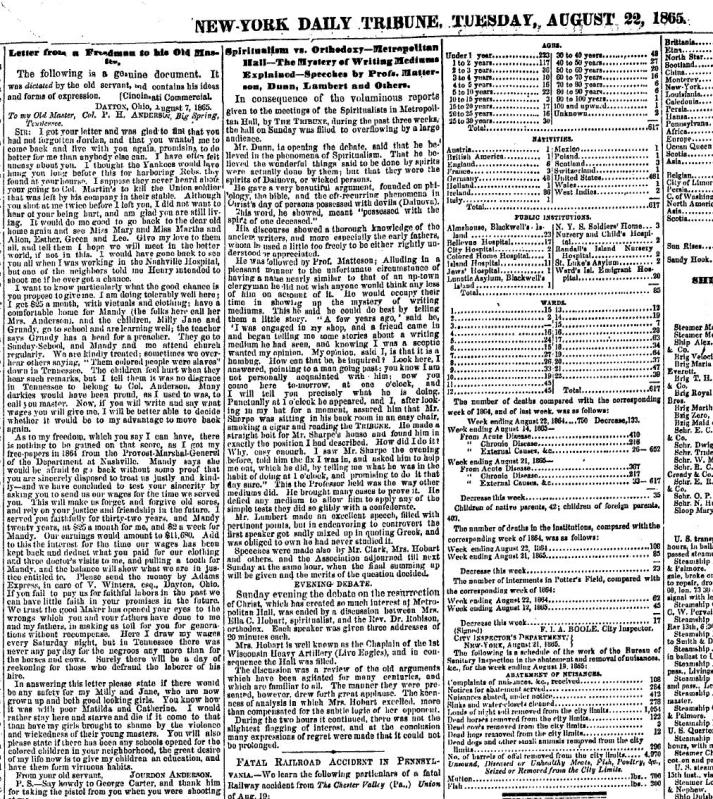
... is really a reprint of this 1865 letter from an ex-slave to his old master. I'll let Letters of Note take it away:


In August of 1865, a Colonel P.H. Anderson of Big Spring, Tennessee, wrote to his former slave, Jourdan Anderson, and requested that he come back to work on his farm. Jourdan — who, since being emancipated, had moved to Ohio, found paid work, and was now supporting his family — responded spectacularly by way of the letter seen below (a letter which, according to newspapers at the time, he dictated).

Rather than quote the numerous highlights in this letter, I'll simply leave you to enjoy it. Do make sure you read to the end.

(Source: The Freedmen's Book; Image: A group of escaped slaves in Virginia in 1862, courtesy of the Library of Congress.)


Dayton, Ohio,

August 7, 1865
 
To My Old Master, Colonel P.H. Anderson, Big Spring, Tennessee 
Sir: I got your letter, and was glad to find that you had not forgotten Jourdon, and that you wanted me to come back and live with you again, promising to do better for me than anybody else can. I have often felt uneasy about you. I thought the Yankees would have hung you long before this, for harboring Rebs they found at your house. I suppose they never heard about your going to Colonel Martin's to kill the Union soldier that was left by his company in their stable. Although you shot at me twice before I left you, I did not want to hear of your being hurt, and am glad you are still living. It would do me good to go back to the dear old home again, and see Miss Mary and Miss Martha and Allen, Esther, Green, and Lee. Give my love to them all, and tell them I hope we will meet in the better world, if not in this. I would have gone back to see you all when I was working in the Nashville Hospital, but one of the neighbors told me that Henry intended to shoot me if he ever got a chance. 
I want to know particularly what the good chance is you propose to give me. I am doing tolerably well here. I get twenty-five dollars a month, with victuals and clothing; have a comfortable home for Mandy,—the folks call her Mrs. Anderson,—and the children—Milly, Jane, and Grundy—go to school and are learning well. The teacher says Grundy has a head for a preacher. They go to Sunday school, and Mandy and me attend church regularly. We are kindly treated. Sometimes we overhear others saying, "Them colored people were slaves" down in Tennessee. The children feel hurt when they hear such remarks; but I tell them it was no disgrace in Tennessee to belong to Colonel Anderson. Many darkeys would have been proud, as I used to be, to call you master. Now if you will write and say what wages you will give me, I will be better able to decide whether it would be to my advantage to move back again. 
As to my freedom, which you say I can have, there is nothing to be gained on that score, as I got my free papers in 1864 from the Provost-Marshal-General of the Department of Nashville. Mandy says she would be afraid to go back without some proof that you were disposed to treat us justly and kindly; and we have concluded to test your sincerity by asking you to send us our wages for the time we served you. This will make us forget and forgive old scores, and rely on your justice and friendship in the future. I served you faithfully for thirty-two years, and Mandy twenty years. At twenty-five dollars a month for me, and two dollars a week for Mandy, our earnings would amount to eleven thousand six hundred and eighty dollars. Add to this the interest for the time our wages have been kept back, and deduct what you paid for our clothing, and three doctor's visits to me, and pulling a tooth for Mandy, and the balance will show what we are in justice entitled to. Please send the money by Adams's Express, in care of V. Winters, Esq., Dayton, Ohio. If you fail to pay us for faithful labors in the past, we can have little faith in your promises in the future. We trust the good Maker has opened your eyes to the wrongs which you and your fathers have done to me and my fathers, in making us toil for you for generations without recompense. Here I draw my wages every Saturday night; but in Tennessee there was never any pay-day for the negroes any more than for the horses and cows. Surely there will be a day of reckoning for those who defraud the laborer of his hire. 
In answering this letter, please state if there would be any safety for my Milly and Jane, who are now grown up, and both good-looking girls. You know how it was with poor Matilda and Catherine. I would rather stay here and starve—and die, if it come to that—than have my girls brought to shame by the violence and wickedness of their young masters. You will also please state if there has been any schools opened for the colored children in your neighborhood. The great desire of my life now is to give my children an education, and have them form virtuous habits. 
Say howdy to George Carter, and thank him for taking the pistol from you when you were shooting at me. 
From your old servant, 
Jourdon Anderson.

Given some of the reignited debates over the American Civil War and Abraham Lincoln's legacy that we've been exposed to recently, I find this a wonderfully serendipitous discovery. Beyond the simple matter of timing, it's contents serve to show up some contrarian notions of slave-owner compensation with an wistful humour and stark clarity that even Ta-Nehisi Coates can only envy.

HT: Michael Clemens