Sunday, February 27, 2011

George Selgin on the Action Axiom

Plus my reply.

I was pleasantly surprised to see George Selgin leave a comment underneath my previous post concerning Mises's action axiom. In case you missed it, I had quoted a paragraph from an old journal essay of his before voicing my concerns over the extent to which Mises's action postulate could be defended as a truly self-evident axiom (i.e. along the lines proposed by Immanuel Kant [*]). Instead of responding further in the comments section of that post, I rather feel that my reply here is long enough to warrant a post of its own.

[Obviously, I encourage you to read my original post and see his full comment before continuing...]

While I wish to address several points simultaneously, I think that it's best to acknowledge Selgin's final point first:
I don't mean to suggest that I would go out on a limb to defend everything that's in my essay (I wrote it as a grad school paper in '82, and like to think that I've learned plenty since).
Of course, and I would not expect him to. That being said, I should think that he still regards the quoted paragraph as an accurate reflection of what Mises believed and what most Miseans continue to assert to this day. Indeed, I could cite a number of near identical quotes by other authors in confirmation of what Selgin wrote. (E.g. Compare the top paragraph of page 7 in Hans-Herman Hoppe's widely cited essay, Economic Science and the Austrian Method.)

That being said, I'm not claiming to be an expert on the praxeological method or the extent to which Mises anticipated the criticisms of his therory. If this wasn't clear enough from my essay, it was precisely for this reason that I have invited rejoinders to my argument from people who are more familiar with Mises than myself. Among other things, I appreciate the pointers to original material where Mises and his followers have tried to address some of specific issues that I highlighted.

However...

I will certainly object to Selgin saying that I missed the part about purposeful behaviour. Indeed, I see the issue of "purpose" as being at the very crux of my argument. Thus, when he writes "praxeology is only concerned with explaining human action to the extent that it is purposeful", I would submit that this simply reinforces the tautological bent that praxeologists are so keen to defend against. Put differently, this is really just an admission to framing economics within the constructs that specifically suit praxeological analysis[**]. This may be a convenient tautology arrangement, but:

1) It then begs the question: Why the need to invoke Kant at all? When you have already specified the terms and limits of your engagement -- i.e. purposeful behaviour -- all this Kantian talk about (non) self-contradicting synthetic a priori truths becomes redundant. I mean, would it really be that different to saying "Homo economicus is only concerned with explaining human behaviour to the extent that agents are rational and narrowly self-interested"? I don't think so.

2) Praxeologists (and Austrians in general) need to be very, very specific about what they regard as non-falsifiable truths and the extent to which it applies to economics in general, or even invalidates other economic theories. While good praxeologists may already have suitably honoured this requirement -- I'm not in a position to say for sure -- I certainly don't think that they've done a very good job of communicating this to the broader economics community, which leads me to...

A final comment: I am rather new to this debate and all this may be old hat for people like George. Indeed, looking back over his comment, I get the strong impression that we may ultimately be saying the same thing; perhaps just coming from different perspectives. However, as per the thrust of my original argument, I would be fine with all this if it weren't for the fact that I keep encountering (so-called) Austrians who emphatically insist that economics requires no empirical validation or arbitration between competing theories.[***]

---

[*] In his Critique of Pure Reason, Kant argued that we can establish known truths, free of the need for any empirical validation. He proposed the existence of so-called synthetic a priori truths, which could not be denied without  some element of self-contradiction. In other words, you require X to attempt a denial of X and thereby, implicitly, admit to its truth.

[**] Not that there is anything wrong with making simplifications and assumptions; any theoretician does this (though some are undoubtedly better than others). However, as long as you admit to doing this, then you necessarily narrow the scope of what you are able to study or "prove" without the aid of good empirical work or further theoretical consideration.

[***] I blame the internets! On a more serious note, I am aware that there is something of Austrian schism between the followers of Hayek and Mises on this issue of epistemology. Indeed, Hayek's "Popperian" stance is one reason why I find him a much more compelling economist that Mises.

Thursday, February 24, 2011

Mises's action "axiom" or false dichotomy?

I've been watching the recent libertarian conundrum - concerning the morality of using taxes to prevent a killer asteroid from wiping out humanity - with great fascination. For anyone not privy to the whole saga... Essentially, some (uber) libertarians have made it plain that they would rather die with their principles than see some thievin' gub'mint send up a Bruce Willis-type into space to blow up any asteroid on the back of stolen tax money. [Side note: I was planning to draw some fun parallels to global warming, but John Quiggin beat me to it.]

Lest it be unclear, I am firmly in the camp that proclaims such positions as absurd. Further, it appears that many self-proclaimed libertarians count themselves in the same boat. I'd be worried if they didn't; it would elevate a cut-off-your-nose-to-spite-your-face mentality to an astronomical level, so to speak. Now, there have since been some more nuanced defences along the lines of: "I would contribute; I just don't think you can force other people into contributing." However, from my perspective these positions still overlook the free-rider problem and ultimately equate to little more than a form of culpable homicide. (You can see some of my comments on these issue here.)

All this, however, is just a prelude to what I want discuss here.

Amidst the whole asteroid palaver, I saw an interesting discussion between Daniel Kuehn and Jonathan Catalan. In particular, on why we shouldn't conflate the responses of Austrians with libertarians regarding this matter; even though many Austrians would certainly identify themselves as libertarians, and (I imagine) vice versa. I thought Jonathan's point about these two groups deriving their end-points as the result of distinctly different processes - positive for Austrians vs normative for libertarians - was well made. My interest piqued, I started doing a little internet research to see what else might have been said about the strong link between Austrian economics and libertarianism in spite of their opposing methodologies. Had they been unified through a grand string theory of liberty?

Unfortunately, I got distracted.

And now, finally, we get to the meat of today's post...

A question occurred to me while I was reading a passage by George Selgin, explaining why (many) Austrians hold Ludwig von Mises's praxeological method to be the most valid form of all economic reasoning. Following Immanuel Kant, it basically boils down to a belief that the human action axiom cannot be refuted, because, as per Selgin (pg 22):
To meaningfully deny the "action axiom" (i.e., the claim that people act purposefully) is difficult. Denial of the axiom's empirical validity involves a purposeful act on the part of skeptics. It therefore confronts them with the uncomfortable choice of either conceding the issue or proclaiming that their own disagreement is purposeless. Thus, any denial of the action axiom is self-contradictory.
Am I the only that sees an obvious philosophical objection to this? It extrapolates from a single (contrived?) instance and purports to have shown that the same rules must hold for all human actions over all of time. Near as I can tell, this is done without further justification.

To put things differently, just because I act purposefully at this one particular moment in time (i.e. by denying the action axiom), how does rule out the possibility that I may have acted in a non-purposeful way at any other moment? Indeed, I would think that if someone did try to deny the action axiom, their position would very likely be based on past events and experiences that are completely independent of the present “catch-22” moment. You could easily argue that framing things in such a way – to assume that people act must purposefully at all times, or not at all – is a false dichotomy that invalidates the claim to (strict) apodictic truth.

At best – or worst, depending on your position – it therefore seems to me that denying the action axiom is only momentarily self-contradictory, not an exhaustive set that is valid over all time.[*]

A rather laboured analogy [slightly adapted to make things a bit clearer- Ed.]:
MARIO: "Hey Luigi, are you awake?"
LUIGI: "No."
MARIO: "A-ha! But you have to be awake, since you just answered me. So... Proof that you don't sleep!
LUIGI: "Huh?"
Etcetera.
Anyway, this seems such an obvious objection to me that I can't shake the feeling that a) someone has already proposed it (to possible counter-argument), or b) I'm wrong in an even more obvious way. So, followers of Mises: Hit me with it! 

OTOH, if there is merit to my argument, then I imagine that it opens up the possibility for Austrians, on philosophical and logical grounds, to at least engage in empirical testing of their theories and thus expose them to the scrutiny of falsifiability.

UPDATE: See follow-up here.

Disclaimer: I am in no way disputing the argument that the people generally act with the purposeful intention of improving their situation... i.e. the benefits of voluntary trade, etc. Indeed, I take this to be one of the fundamental pillars of economics and, despite his novel application, Mises was hardly the first to suggest it.(I'm not suggesting that he made this claim.) What I am trying to establish, however, is whether we can truly and with universal certainty describe "human action" as an apodictic axiom, when the key defence rests on a flitting moment of self-contradiction under very specific circumstances.
___
[*] Compare Decartes’s epiphany: “I think therefore I am”. I regard this as a valid synthetic a priori fact (a la Kant), precisely because it concerns only the present moment, i.e. “I am”.

Monday, February 21, 2011

Tort law is no panacea for the environment

Looking over the comments section of an old post, I realised that I had yet to make good on a promise to "flesh out my scepticism regarding the ability of tort law to meaningfully contribute to climate change action" (or, alternatively, expose it as a sham). Essentially, a friend of mine with strong anarcho-capitalist leanings had suggested that the climate impasse could - and should - be resolved through the private courts rather than any type of government regulation that seeks to create, for example, a carbon price via cap-and-trade or carbon taxes. I have just left my response underneath his comment as to why I regard this stance to be wholly unworkable in practice. I invite you to look over my points and see whether you agree or not. (The summary version: Non-representation of future claimants, and the complete impracticability of claimants to adequately and fairly engage separate carbon producers from all over the world; and vice versa).

Anyway, moving beyond the specific case of climate change, this is leads me to the consideration of tort law as a means of addressing environmental ills, generally. Indeed, I would say it is very much related to something that's central to my specialisation: The role of markets (underpinned by legal institutions like tort law) versus the role of governmental regulation in dealing with environmental problems. Before continuing, let me first say that my usual position on economic matters is fairly uncontroversial in that I regard markets as vastly superior to any supervening government force. Freedom to choose, responsibility for our own actions, etc, etc...

However, as an environmental and resource economist, I am constantly brought up against cases where markets don't work particularly well, or, alternatively, no market exists to deal with the provision of certain goods. That is the nature of our specialisation; we have to consider externalities, fuzzy property rights, environmental public goods, and other market "failures". Even with these imperfections, I am inclined to heed the words of one of my university professors who said something to the effect of: "Always consider other options before getting involved in environmental policy, because outside actions have the potential to stuff things up proper make matters even worse".

Having said that, there are still undoubtedly many cases where government intervention and regulation has led to improvements in environmental outcomes and natural resource management. Further, it's no coincidence that such instances often invoke market mechanisms, thereby simulating artificial scarcity and conferring property rights. This ultimately creates the right set of incentives for people to act in a profitable way to address environmental issues.[*] I can name many, many examples... From the rejuvenation of previously endangered fisheries, to the reduction of acid rain.

Even if we ignore such successes, I find it curious that certain libertarians continue to hold an unshakeable belief in the efficiency of tort law to resolve all environmental ills in an otherwise unregulated market. Regulation, on the other hand, is seen as nothing more than unworkable nonsense cobbled up by a lumbering coalition of bureaucratic imbeciles and self-serving politicians. This position seems to not only understate the transaction costs and asymmetries of information and financial power in a real-world market system, but also thoroughly oversells the efficiency of our legal systems. So, in addition to the points that I tried to highlight specifically with regards to climate change, here are some additional factors that I believe limit the effectiveness of tort law when it comes to addressing environmental problems on a more general scale:

First and foremost, litigation takes a very long time and can be hideously expensive... especially when there is money and power involved. It's easy to cite a number of high-profile environmental and health incidents that illustrate this. Exxon took 20 years to pay out after the Valdez oil spill off Prince William Sound. Officials from Union Carbide were still embroiled in criminal proceedings upon the 25th anniversary of the Bhopal Gas Disaster in India (although the company had made an out-of court settlement in 1989). More recently, Chevron has vowed to overturn a landmark $8.6bn fine imposed by a court in Ecuador in a case that has already been running for 18 years. Because of these factors, there is an inherent bias towards groups with money and legal clout. Legal disputes are hardly ever a fair fight between equals; it's about who brings the best lawyers to the party and who can confidently front the costs for the entire (possible) duration of a trial.

These are pretty fair indications of how inefficient legal systems can be, with endless recourse to stalling and appeals. Indeed, (good) regulation is often aimed at circumventing inefficient and protracted tort processes such as the ones that I have highlighted. In other words, it helps to reduce transaction costs to a minimum.[**]

To be sure, unchecked government meddling in production and industrial processes can have - and has had - very damaging consequences to both human beings and our environment. For instance, the Indian Government had a heavy hand in the Bhopal Plant and may be as liable as anybody for the tragedy that ensued. However, I don't see that as particularly relevant to the sheer length of the subsequent court case. Moreover, if regulation is dangerous because it affords power to supposedly disinterested third parties, would judges and juries not be susceptible to this influence too? Or, more simply, could they not also be subject to making the same bad decisions that stand to affect both current and future outcomes through the rule of legal precedent?

This leads me to another weakness underpinning our legal system: It lacks the very mechanism that makes markets work so efficiently. That is, there is no comparable profit-loss mechanism that leads self-interested parties to drive a continual improvement of the system. This idea was succinctly captured in a recent paper by Nobel Laureate James Buchanan: The Limits of Market Efficiency. As a pioneering figure in public choice theory, Buchanan did as much as anyone to highlight the fallibility of government authorities in being effective regulators. In this paper, however, he sets to balance the scales by showing that a) markets "work" only under certain legislative frameworks, and b) these frameworks are themselves devoid of forces that would make them inherently optimal. Here's a snippet:
Consider[...] the differences between the spontaneous emergence of a body of law, a set of rules, and the allocation of valued resources in the market process. In the latter, [...]opportunities for securing differential private rents and avoiding differential negative rents are open and available to prospective entrepreneurs-arbitrageurs, whose behavior, in itself, becomes part of the correction that efficiency conditions require. Contrast this process with application to law. Suppose that a law, rule, or convention emerges and exists, one that is recognized, even if by all participants, to be less enhancing to their well-being than a readily imagined alternative. The opportunity cannot, however, be exploited by single entrepreneurs-artibrageurs because of the nonpartitionability of law, as such. There is nothing comparable to the profit-loss dynamic of the market that will insure any continuing thrust toward more desirable outcomes. 
To conclude, I think that scepticism of government is absolutely justified in many cases, as I have tried to indicate at the beginning of this post and in a number of my previous posts. If there are market imperfections, it doesn't necessarily follow that government involvement will adequately address them. Indeed, it could exacerbate the situation and, frankly, it’s ridiculous to pretend otherwise. Where possible, I absolutely support community/individual management of resources above that of the State, just I support individual responsibility in many economic aspects. I also think that tort law can play an important role in controlling for localised environmental externalities. However, as per my reasons above, I disagree that regulations are inherently inefficient in comparison to a purely market-based system underpinned by tort law. Again, the danger is in applying blanket rules to complex situations that require evaluation on an individual basis.

THOUGHT FOR THE DAY: There is no silver bullet solution to solving our many, and often complex, environmental problems. Those that see tort law as some kind of panacea overlook the very real inefficiencies present in such a system. Consequently, torts remain very useful tools alongside regulatory measures for addressing environmental issues, but I don't believe that they can succeed by, or in of, themselves.

UPDATE: I completely forgot to talk about something that I'd originally meant to include in this discussion; the role that risk plays in limiting the effectiveness of pure market transactions. In particular, how different risk premiums are exacerbated by asymmetries of information, and how this can make it preferable to have some unilateral rule in place that guarantees us a minimum standard of protection from risk, which we cannot otherwise control for. This is very important in the context of justice administered ex post versus ex ante. As I wrote here:
[...] I much prefer driving in a country where standardised driver licenses and road-worthiness tests for vehicles offers me some insurance against risk-prone drivers. There's no way I control for who shares a highway with me, but at least I am reassured that their cars (say nothing of the drivers themselves) are expected to meet certain minimum standards. 
And, of course, I would suggest that "justice" administered ex post is, in many cases, a straggling third best; especially when it comes to more dramatic outcomes like severe injury and death. Don't get me wrong; there's plenty bad regulation out there... But I'd prefer (regulatory?) prevention than (courtroom?) "cure" when the latter involves putting a monetary value on matters that are inherently beyond valuation.
UPDATE 2: In an older blog post, Tyler Cowen points to an AER paper by Susan Rose-Ackerman, Regulation and the Law of Torts, which strongly supports the basic arguments I have made above. Speaking of Marginal Revolution bloggers, Alex Tabarrok co-authored this book a few years ago on the inefficiencies prevalent in the US tort system.

UPDATE 3: A follow-up, of sorts, here.
___

[*] Daniel Kuehn has a really good series of posts in this regard, under the collective heading of calculation verses incentive problems.
[**] Two points additional bear mentioning. First, in all of the above cases claimants were afforded a fraction of the recompense that they were initially promised due, in large part, to the principles of corporate limited liability. In this matter, I am in essentially in agreement with the proponents of tort law that a system of limited liability encourages unduly risky behaviour. To get an idea of my views on limited versus strict liability, please see here. Second, I have seen tort proponents argue that transaction costs are subsidised by government in the case of regulation and therefore of equal weight to transaction costs incurred when markets are left to their own devices. This is a non sequitur. To use a simple example, if government bans the use of lead in petrol unilaterally then transaction costs have essentially been reduced to a minimum. Alternatively, think about how impossible it would be to track down the former owner of each and every plastic bag that happens to blow into your property versus government simply adding a tax to each bag that makes people utilise them in a far more effective and environmentally friendly way.

Thursday, February 17, 2011

Wednesday, February 16, 2011

Junk Bond Trader

I'm a little short on time to post anything substantial, but I figure a music post is overdue anyway. And so, with the news that Bernie Madoff has claimed that the certain banks and hedge funds "had to know" of his elaborate ponzi scheme... It seems as good an excuse as any to recall the genius of Elliot Smith:


The imitation picks you up like a habit
Writing in the glow of the TV's static
Taking out the trash to The Man
Give the people something they understand

A stickman flashing a fine-line smile
Junk bond trader trying to sell a sucker a style
Rich man in a poor man's clothes
The permanent installment of the daily dose

And you tell off when you tell it like it is
Your world's no wider than your hatred of his
Checking into a small reality
Boring as a drug you take too regularly

The athelete's laugh, the broken crutch
The first true love that folded at the slightest touch
Brought down like an old hotel
People digging through the rubble for things they can resell

"Happy Holidays," said Sid the Saviour
The leaving lover that I still favor
I won't take your medicine
I don't need a remedy
To be everything I'm supposed to be
I don't want nobody else
I can do it by myself
We're meant to be together

Now I'm a policeman directing traffic
Keeping everything moving, everything static
I'm the hitchhiker you'll recognize passing
On your way to some everlasting

Better sell it while you can

Just remembering how good the lyrics to this song are. Even a direct reference to "Stickman"! The unflattering context aside, I might be tempted to read more into this if only I had more superstitious leanings...

Monday, February 14, 2011

"Our climate isn't the only green concern"

UPDATE: The forest sell-off has been shelved following a massive public outcry.

That's the title of a short article by Michael McCarthy, the environmental editor of The Independent, in which he discusses the apparent flip-flopping of the new UK government on the sale of public forests. In of itself, this is a very interesting issue because it highlights some the practical problems of privatising "public" land. Being of a market persuasion myself, I have nothing much in principal against private ownership of these resources. Indeed, the success of private game parks all over the world gives us an indication of how well that kind of model can work, often in conjunction (and competition) with state-owned parks, to better preserve our natural heritage.

Of course, the UK's forests are perceived quite differently to game parks. They are, I would argue, probably much closer to, say, beaches in the public mindset. For various reasons, public beaches have become institutionalised as places that we like to enjoy in commons. Perhaps people even like the illusion of them being free to everyone regardless of the fact that tax money is what ultimately supports their maintenance. Having said that, there reasons why this system isn't an inherently inefficient; most notably transaction costs and the problems of exclusion. (E.g. It could be much easier for us to make a single payment to one authority that manages these assets on our behalf than to pay a new owner every time you enter a new park or beach. Further, in the absence of unsightly fencing, it is problematic to police who comes in and out, and who has paid for entrance in the first place). At any rate, I think it's fair to say that many public beaches are both well-run and well-policed.

The major point of McCarthy's article that I want to get to, however, is imbedded in his subject line. He gets down to it in the last two paragraphs:
[T]his Government has conflated "the environment" with climate change; the rest is forgotten (at least at the highest level). It was actually in the specific context of global warming policy that Mr Cameron made his "greenest ever" pledge. He saw, rightly, that saving the climate is of overwhelming importance; but he failed to see that there are other green issues, such as the care of the natural world, which are also immensely important and which the public may deem crucial. 
To be fair, being blinded to everything else by climate change is not the fault of this Government only; some of the traditional green pressure groups have followed suit, and Jonathon Porritt, doyen of green activists, pointed out in an angry blog last week how little most of them have done to combat the attack on nature conservation. But the Government will have to wake up to its mistake, or its pledge to be the greenest ever will turn out to be the biggest hostage to fortune of its time in office.
I wholeheartedly agree with this position. As I've written previously:
"I do worry that important non-climate-related research is being sidelined by this overwhelming debate on AGW [Anthropogenic Global Warming]. Clearly, there are some very important scientific and environmental questions unrelated to climate change that deserve research funding as well. Moreover, its really frustrating to see people trying to lump everything under the climate umbrella or ascribe strong climate causation when there isn't any."
THOUGHT FOR THE DAY: Climate change is a hugely important issue for anyone concerned about the environment, say nothing of human welfare. But shoehorning any and every environmental problem into a climate change story does nobody favours. It distracts focus from other genuine environmental issues and only serves to undermine the legitimacy of the climate change movement in the process.

The "call on OPEC"

Reading through some of those Wikileaks' cables from last week on how Saudi Arabia has been... uh... massaging the true extent of their remaining oil reserves, I was reminded of something dubbed the "call on OPEC".

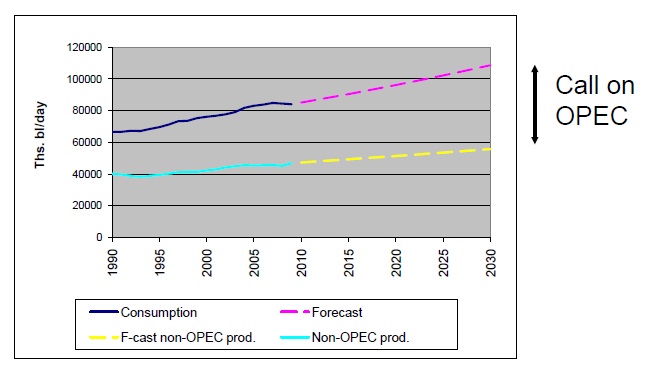
The term was originally coined by the International Energy Agency (IEA) and, essentially, it is a question of whether we can reasonably expect OPEC to make up the (growing) shortfall between future energy demand and the supply coming from other, non-OPEC producers. Or, graphically:

Simple forecasts to 2030 based on average historical growth rates (1990-2009)

Using a very basic forecast as per the above - where the projection is simply an extrapolation of average growth rates since 1990 - we can generate a rough estimate of what the "call" on OPEC will be in 2030. Under these assumptions, OPEC production will have to grow by around 2.3% per year if it is to meet the shortfall in future global energy demand.  Bottom line: OPEC will have to supply an ever-increasing portion of the world's oil.

If you don't care for this simple example, then take OPEC's own word for it, which says that "OPEC will increasingly be called upon to supply the incremental barrel"(pg 10). It also includes the following table:

Adapted from OPEC World Oil Outlook 2010, Pg 71 (Table 1.10)

Taking the above figures as gospel, the implied call on OPEC requires it to increase annual output by 1.8% a year to meet the forecast shortfall in global supply by 2030. Again, the take-home message is that OPEC will almost certainly be expected to supply an increasingly large portion of the world's oil needs.

Is OPEC interested? Is it even capable?

There are various reasons to dispute that they are in either case. For one thing, domestic demand for oil in OPEC member countries continues to rise along with their increasing incomes. Why not keep the oil for themselves? Further, in an environment of rising oil prices, there might be strong incentive to leave reserves in the ground so as to take advantage of higher prices in the future. And now, to really complicate matters, is the possibility that OPEC's principle member, the Kingdom of Saudi Arabia, has been systematically overstating its reserves. It would be remiss of us not to ask whether other members of the cartel have also been overly generous in their estimations of their reserves.

Whatever the case, the world is going to need more fuel than it can easily obtain. Barring some very significant breakthroughs in tar-sand recovery or deep-sea drilling, I wouldn't be putting money on a low oil price any time soon.

UPDATE: Here's an op-ed in the Energy Tribune from September last year that discusses the problems surrounding the "call on OPEC" in more depth. The author, Anas F. Alhajji ("chief economist at Dallas-based NGP Energy Capital Management"), lists five factors that he says will prevent OPEC supplies from meeting the call to global demand. I have already mentioned some of these above (increased domestic demand, leaving reserves in the ground in anticipation of further price increases, etc). He concludes:
The inability to meet the expected “call on OPEC” and the higher prices resulting from shortages will create excellent opportunities for international oil companies, independent producers, and private-equity investors. It will also create an opportunity for other energy sources to fill the gap that OPEC members were expected to fill but did not. 
Indeed, given the expected growth in energy demand in the next two decades, and the possible – even likely – shortfall in OPEC supply relative to the projected “call on OPEC,” the term “alternative energy” will lose its meaning. The only “alternative” to harnessing all feasible energy sources will be a slow-growth world of permanent shortages and increasing misery.

Thursday, February 10, 2011

Wikileaks: Saudis overstating oil reserves

... Apparently by as much as 40%.

Heavy days.

I've yet to read through the actual cables, but The Guardian's summary doesn't paint the prettiest picture:
The US fears that Saudi Arabia, the world's largest crude oil exporter, may not have enough reserves to prevent oil prices escalating, confidential cables from its embassy in Riyadh show. 
The cables, released by WikiLeaks, urge Washington to take seriously a warning from a senior Saudi government oil executive that the kingdom's crude oil reserves may have been overstated by as much as 300bn barrels – nearly 40%. 
[snip] 
According to the cables, which date between 2007-09, Husseini [a geologist and former head of exploration at the Saudi oil monopoly Aramco] said Saudi Arabia might reach an output of 12m barrels a day in 10 years but before then – possibly as early as 2012 – global oil production would have hit its highest point. This crunch point is known as "peak oil". 
Husseini said that at that point Aramco would not be able to stop the rise of global oil prices because the Saudi energy industry had overstated its recoverable reserves to spur foreign investment. He argued that Aramco had badly underestimated the time needed to bring new oil on tap. 
Nothing is fucked here, Dude
Intriguing times, indeed.

UPDATE: A more cornucopian take on this whole saga from Michael C. Lynch here. Although, it would be remiss of me not to show you this Forbes article from 2006, where Lynch was confidently predicting that oil prices would dip to $20/bbl by 2008...

Two quick links - Krugman edition

Paul Krugman is the ultimate polarising force. People either love him or loathe him. I suppose that's what comes with the territory when you are, arguably, the world's most high profile economist.

Anyway, seeing as I referred to him in my previous posts on climate change and food prices, here are two links that seem kinda relevant.

1) Roger Pielke Jr has a post criticizing Paul Krugman's citiation of extreme weather events in which he questions any causation between long-run carbon levels and food prices. I left a comment saying, among other things, that I regard his invocation of the historical food record as tempting the gods of false equivalence. I also think that he's being uncharitable in his basic reading of Krugman's argument. Still, it's an interesting debate with thought-provoking points raised on both sides... I'd especially like to see whether more people pick up on my comments about Norman Borlaug and the possibilities of another "Green Revolution".

2) Back to PK himself, who, in commenting on the American Economic Review's "Top 20" papers of the last 100 years, had this to say:
It’s also worth noting that a number of the papers on the list involve very simple, intuitive models — that includes Friedman on the natural rate, Krueger on rent-seeking, Mundell on currency areas; Shiller’s great piece on stock volatility was also a remarkably simple concept yielding a powerful insight. My own paper was actually pretty math-heavy; uncharacteristically, it’s also a paper in which doing the math fundamentally changed my mind about things (I didn’t believe the home market effect was real until it popped out of the equations; only then did I realize it was obvious.)
Hmmm. Sounds kinda familiar...
Further, and I would say more importantly, [maths] enables us to fully work through the consequences and dynamics of [economic] relationships. Our intuition may suggest certain outcomes, but intuition can be pretty limited in scope. Working through a set of equations enables you to arrive at a final result with a cool clarity, which may then show up unexpected results that only become “intuitive” upon further reflection.
;)

o-[-<

Wednesday, February 9, 2011

Discount rates, relative prices and climate economics

Yesterday I wrote a bit about the "relative prices" argument for swift and decisive action against climate change. Some additional comments to provide context:

For economists engaged in the climate change debate, one of the most important – yet difficult – things to find agreement on is a suitable discount rate. This may seem a strange issue to fixate on from the perspective of non-economists, but the point here is that climate change is an intergenerational problem that will potentially affect many people over time. The question then is how to measure future costs and benefits against those of the present?

As with any investment which involves cost-benefit analysis over time, the favoured approach in climate change economics is to use a discount rate.[*] This allows us to assess things in present value (PV) terms. Thus, and while it may seem somewhat trivial against the wider scientific uncertainties of climate change, the discount rate actually proves a critical factor in determining the economically efficient level of abatement. Here's a simple example to illustrate the importance of choosing a particular rate of discount:
If we discount \$100 a hundred years from now at a rate of 1 percent, we obtain a present value of around \$37. However, if we feel slightly more impatient and raise the discount rate to 3 percent, then the present value falls to only \$5!
Importantly, the effect of compound interest means means that we see an exponential impact from the difference in discount rates, as well as the length of time that we are discounting. In other words, we're dealing with a distinctly non-linear process.The central message to take away is that – when it comes to estimating economic costs and benefits of the future – seemingly innocuous changes in your a priori assumptions over the discount rate can lead to substantial differences in cumulative terms. (Use this calculator to see for yourself.)

So, the choice of discount rate has a potentially massive impact on the perceived efficiency and timing of climate policy. Again, it is worth emphasising the intergenerational nature of climate change, where present (and future) sacrifices will have to be made in order to protect future incomes and utilities. The corollary of this is that acting too slowly may harm future generations in the form of rising climate costs, whilst acting too quickly may be equally as harmful by unnecessarily limiting economic growth.

Against this background, it probably won't be surprising to hear that the chief criticisms for the much-feted Stern Review –  from an economics perspective at least –  were reserved for his choice of discount rate. By drawing on the famous Ramsey Equation[**], Stern used largely ethical arguments in deriving a final discount rate of 1.4%. This, his critics argued, was much too low in comparison with observed market rates, which are closer to 3-4%. Moreover, since Stern's major findings hang on a "low" discount rate, the same critics say that his central policy recommendation of "act fast, act now" does not hold. (Indeed, a belief in higher discount rates is what underpins a lot of economic rationalisation on the benefits of delayed action against climate change; e.g. focus on growing our economies as fast as possible now so that we will be in a better, wealthier position to deal with the effects of climate change in the future.)

At the same time, however, numerous other economists have come out strongly in support of Stern, while he also has vigorously defended his methodology in the period since. In the interest of keeping this post as short as possible, I won't go into much further detail on this debate between supporters of Stern and their opponents (or those in between). I highly encourage you to look over the Sterner and Persson paper that I recommended previously for a very readable summary of the various elements involved in determining the discount rate, as well as the different schools of thought on what the appropriate level really is.

What I did want to get to today was this: One of the most interesting insights of the "relative prices" argument from my perspective is that strong, early emissions reductions can be economically justified even in the presence of high discount rates. Prior to this, opponents to early abatement paths such as those proposed by Stern have argued that such plans can only be sustained in the presence of what they perceive to be unacceptably/unrealistically low discount rates. And yet, we now see compelling economic reasons to follow an aggressive emissions path even when using high rates of interest.[***]

In other words, the relative price argument allows us to partly abstract from the intrinsic subjectivity of the discount debate, which currently clouds the timing of climate policy. It does this by demonstrating the extent to which a loss in natural assets (clean water, predictable seasons, etc) could affect our ability to generate, or even enjoy, man-made assets (such as cars, computers, restaurants and so on) in the future. In this way, we are able to formalise the intuitive concerns that many people have regarding the destabilisation of natural systems that we are intimately dependent on.

THOUGHT FOR THE DAY: The choice of discount rate is crucial to determining an "economically efficient" response to climate change. Unfortunately, there is widespread disagreement among economists as to what the correct discount rate is. However, by incorporating the impact of relative prices into our analysis, we can still conclude that it is better to act sooner, rather than later... even if we assume a discount rate that is relatively high. And that is a critical first step to reach agreement on.

-----
[*] There are people who question the validity of even using the "standard" cost-benefit analysis (CBA) approach to climate change, but that remains another subject for another day.

[**] The Ramsey Rule is: r = δ + η * g 
        Which says that the discount rate (r), is equal to the sum of the pure rate of time preference (δ) and the product of the elasticity of the marginal utility for money (η) and the per capita growth rate of the economy (g). To simplify, we interpret the first component of the equation, δ, as the tendency to discount future utility simply because it is in the future. The second component, η * g, implies that we value future consumption less than consumption today, because our wealth should increase over time as the result of economic growth. This latter notion rests on the assumption that a rich person gains less welfare than a poor person for a given quantity of money.

[***] This is a bit of a simplification. The choice of discount rate will always have an impact on how aggressively we approach the issue of climate change. However, we are left with a central message that – regardless of differing opinions on what the discount rate should be – it is still in humanity’s best interest to decisively cut emissions sooner rather than later.