Sunday, October 21, 2012

The plot thickens in the debt debate

Since joining this debate, I have consistently argued that deficit financing is no less sustainable than taxation if economic growth is at least equal to the interest rate (i.e. g >= r). The models that I have discussed so far always seemed to assume that the reverse was true, so it was completely unsurprising that future generations ran into trouble in these scenarios at some point. It was an inevitable outcome of the design.

As a corollary of this, I also assumed that individual's utility would not be adversely affected if g >= r. To be sure, some important qualifications need to be made here. Most notably, in economics we typically assume that people have diminishing marginal utility (DMU) with respect to consumption. This effectively means that they value losses higher than equivalent gains at any given income level. (If I have 100 apples, then I would lose more utility from having three apples taken away from me, than I would gain in utility if someone gave me three apples.) Of course, this is why we generally think it is better to tax rich people and give that money to poor people, rather than the other way around. 

In this case, deficit financing would improve individual utilities if it meant transferring money (or apples) from a young generation that was wealthier than the old generation.[*] The relatively poor old generation would value the gain in apples more than the rich younger generation would value their loss. And, of course, it certainly seems reasonable to assume that old people will be earning less direct income than young people at any moment in time (due to retirement, etc). This is at least a standard assumption in the OLG literature to the best of my knowledge. I tried to make these points more explicitly in this comment to Nick Rowe... 

However, I had something of an epiphany walking home from the pub last night. (Two epiphanies if you include the realisation that I really should have brought an umbrella with me.):

What if high GDP growth is actually bad for individual utility when a government is using deficit financing? More specifically, what if g > r is the very thing that causes the utilities of future generations (at some point) to fall relative to what they would have been under the laissez faire scenario? This may seem pretty counter-intuitive -- at least it was to me until last night -- but the reasoning is actually pretty simple. Again, it comes back to our old friend: diminishing marginal utility (DMU).

If g exceeds r then at some point a "poor" old generation will be relatively more well off next to their "rich" young selves. Economic growth will outstrip the relative increase in bond repayments. In this case, DMU kicks in such that the transfer from young to old becomes a net "loss"... at least relative to non-intervention scenario. 

I'm not sure whether this is an easy point for people to digest in written form. I sense that it would be much easier to show this in mathematical terms than the long verbal description that I have given above. Nonetheless, I've actually made an Excel spreadsheet that shows that the intuition is correct. As soon as someone is able to tell me how I can upload an active Excel sheet to a blog, I'll do so. [UPDATE: Here it is.]

Make no mistake, g =? r is not the only thing that matters here. Another key issue, for example, is the ratio of old people's incomes relative to the incomes of young people. That's why I want to upload an interactive version of the spreadsheet, so that people can play with different parameter values to see how relative utilities are affected.

I don't know what this means in the context of original blogosphere debt blowout. Frankly, I'm not even particularly interested in who said what at this point. The assumptions that we've been working with are pretty far removed from many of the real-life reasons for taking on debt in any case (e.g. Debt could spur innovation or actually boost economic growth relative to the counterfactual). However, it was an interesting "theoretical" result for me. Nick Rowe may have been making a more profound point than even he realised.

___
[*] Strictly speaking, what matters in this case is that any young individual (or cohort) is relatively wealthy relative to their older selves. I have more disposable income available when I am working than when I am retired.

Friday, October 19, 2012

Even more debt and inheritance (and sales)

Bob Murphy and another commentator have left some interesting observations underneath my last post. They basically want to distinguish between straight-up bequests versus the sale of bonds to the next generation. I was going to leave a response there, but figured that this may be long enough to warrant it's own post.

Bob writes:
You're right, if people in the future are literally bequeathed the bonds from the previous generation, then they are OK (holding all other bequests constant). But what if the previous generation *sells* the bonds to them? Then they're screwed.
My immediate response is to say: "Okay, but what if these young people buy bonds only to resell them to the next generation in the following period?" That seems perfectly consistent with the other assumptions of this model. Taking it for granted that this option is available to every subsequent generation, we would be in exactly the same position as we started with. i.e. This is ultimately a problem of GDP growth being lower than the interest rate... Something which everyone seems to agree upon.

As a thought experiment, however, let's consider the alternative: What if the younger generation refuse to buy the bonds off the old generation? These old timers are now stuck with bonds that they can't sell and, assuming that they decide not to leave any bequests out of spite, what happens next? Well, surely both the bonds and corresponding government debt are extinguished at the start of the next period. In this case, government no longer has a need to finance any outstanding debt burden. We are back to the laissez faire outcome for all future generations.

To be sure, in this scenario one particular generation -- (e.g.) Frank -- will be made worse off, at the same time as everyone else is fine. However, having said that, government could step in at period 6 to maintain Frank's lifetime utility. It does this by taxing Young George an eye-watering 96 apples and transferring them to Old Frank. Of course, now the government is finally at an impasse in period 7. It physically cannot tax Young Hank enough to offset (Old) George's initial losses, since 96*2 > 100 annual production. However, that is an artefact of the model set-up, where any form of debt financing is de facto unsustainable given that we have imposed a positive interest rate and zero economic growth!

The way I see it, this keeps returning to one unavoidable conclusion: The "bad" outcomes of Bob's model can all be traced back to the fact that the interest rate exceeds GDP growth. Everything else is paper fodder.

Thursday, October 18, 2012

Debt and inheritance

UPDATE: Spotted an important typo in the text that I've now corrected for. I've also added a sentence or two to the paragraph before the Baker quote to hopefully make things clearer.

Believe it or, but there are people out there who haven't been following this whole government debt debate from the very beginning. (That is, whether locally financed debt can ever really be a burden to future generations since we effectively owe it to ourselves. ) After a recent link from Daniel Kuehn, I finally decided to bite the bullet and have a quick look over some posts. I may be covering very stale ground here, but please bear with me while I wade in at this very late stage.

Right, so following from Daniel's links, I've clicked through to Bob Murphy's blog. Bob is shameless about his addiction to this debt issue and apparently has infinity + 1 posts on it. I've read these two. (And didn't even make it to the comments!) 

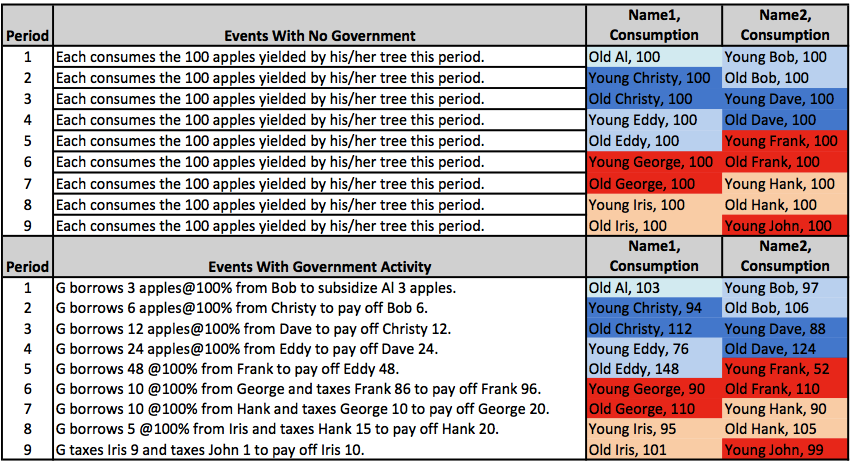
Bob neatly summarizes his (and Nick Rowe's) position via this nifty table, which shows an OLG endowment economy with 100 apples produced in each period and a 100 percent interest rate:


Using the above, Bob claims victory over people like Dean Baker and Paul Krugman, who have ostensibly been arguing that public debt cannot make an economy poorer if it is owed to its citizens. (We can see that all the people in red colouring from period 6 onwards are worse off.)

Nonetheless, I immediately have several questions upon seeing this table, including the obvious comment that you will always run into long-run problems if the interest rate exceeds GDP growth. Nonetheless, I'll stick to my most structural observation:

All the action effectively happens in period 6 when the government switches financing schemes. (In addition to young people financing old people, those same old people are now also being used to "pay back" their younger selves.)

However, it seems to me that Bob's model is missing the fundamental part of Baker et al.'s argument. Clearly, "old" Frank is not being compensated for the money that he is being taxed to pay back to his "younger self". In other words, it is the switching of financing schemes that matters. As I understand the Baker et al. argument, Frank should have 86 apples' worth of bonds in period 6 that must be left to someone when he dies. No-one inherits "Old" Franks' bonds and, consequently, they can never be redeemed.

Here is Baker making this exact point:
As a country we cannot impose huge debt burdens on our children. It is impossible, at least if we are referring to government debt. The reason is simple: at one point we will all be dead. That means that the ownership of our debt will be passed on to our children.
I think that a faithful representation of the Baker and Krugman argument would include the inheritance of bonds. In this case, from Old Frank to (say) Young Hank and so on. Of course, doing so here would mean that you run into a big problem because debt now exceeds total repayment ability. (i.e. 86 rolled over to period 7 at 100% interest is 174, which is obviously more than the 100 income available in any one period.) However, this is an entirely separate  issue and again stems from the fact that this particular model assumes an interest rate of 100%, while GDP growth is zero.

As it stands, and with apologies Inigo Montoya, I'm not sure that this table means what people think it means.

Monday, October 8, 2012

Climate, economy and ladies

As a postscript to the previous entry, here's a quick story about a newspaper interview that I had last week. It was with one of the major broadsheets of the region and related to the launch of our new website.

The interview itself went pretty well, I thought. The journalist was mostly interested in discussing our aims, as well as how we perceive the public's general understanding of environmental issues from an economic perspective.

At one point, he asked the inevitable question of how I ended up in Scandinavia all the way from Cape Town. I told him that it was mostly down to my interests in these very issues. You'd be hard pressed to find a country that has a better track record of managing its natural resources than Norway. It didn't hurt that I was also lucky enough to receive some generous funding offers.[*]

However, I went on to tell him a joke that I had heard from another Southern Hemisphere expat upon arrival, which is that people like us usually find ourselves in Norway for one of two reasons: Oil or women. It was a throwaway line of course (and quite obviously a jape), and I didn't think much more of it...

I suppose it reflects my media naivete then that I was surprised[**] by the headline that ran above my interview the next day: "Climate, economy and ladies".
___
[*] E.g. For those of you thinking about doing a PhD -- but can't bear the thought of scraping by on a measly tuition stipend for four/five years -- consider this: Doing a PhD in Norway is treated as a job and you are paid accordingly. That is, your salary has to be somewhat comparable with what a Master's graduate could typically earn outside of academia. Accepted PhD candidates are thus awarded a "research scholarship" which currently amounts to around US$71,000 per annum...
[**] Mind you, probably not as surprised as my (non-Norwegian) girlfriend.

Review: Surviving Progress

Apologies for the lack of posting recently. Aside from research stuff, most of my "internet" time has been spent working on the RECONOMICS HUB.[*] We have now officially gone live and will hopefully see a consistent level of posting from the various contributors in the weeks and months to come. Please free to stop by and let us know what you think... or follow us on Twitter!

My latest contribution to the blog is a review of the film Surviving Progress (produced by Martin Scorsese). To summarize, the film is long on intent and activism, but often fails to make a convincing argument. A snippet:
In another segment, the film jumps from Ronald Wright’s idea of a “progress trap” — something which certainly has merit in of itself — to claim that modern technology is at complete odds with our primitive physiology. (Wright: “We are running 21st century software, our knowledge, on hardware that hasn't been upgraded for 50,000 years.”) The language is undeniably provocative but is it necessarily meaningful? After all, our knowledge and innovations didn't occur in a vacuum. It is certainly hard to believe that any technological development can persist without bringing at least some form of benefit to its progenitors. The very strong conclusions that the film draws don’t necessarily follow from the premises that it provides.
Surviving Progress relies on a number of interviews and some of these work better than others. I was particularly unimpressed by a clip involving "geneticist/activist" David Suzuki, who is unilaterally scathing about the economics profession. (He calls conventional economics "a form of brain damage").
So, according to Suzuki, “externalities” is a collective term that economists use to explain away pesky things like the ozone layer, topsoil and biodiversity. Hmmm… 
There’s no other way to put this, so I’ll simply come out and say that Suzuki has completely mangled the concept of economic externalities. I cannot think of a single economist who subscribes to anything approaching the definition that he gives. (I’d even be surprised if anyone that has followed an ECO101 class would define an externality in this way.) Suzuki could open any introductory economics textbook and discover that an “externality” is simply some spillover cost or benefit incurred by a third party, which is not accounted for in the market price.
___
[*] Resources. Energy. Climate. Economics

Tuesday, September 11, 2012

Google this

2 sqrt(-abs(abs(x)-1)*abs(3-abs(x))/((abs(x)-1)*(3-abs(x))))(1+abs(abs(x)-3)/(abs(x)-3))sqrt(1-(x/7)^2)+(5+0.97(abs(x-.5)+abs(x+.5))-3(abs(x-.75)+abs(x+.75)))(1+abs(1-abs(x))/(1-abs(x))),-3sqrt(1-(x/7)^2)sqrt(abs(abs(x)-4)/(abs(x)-4)),abs(x/2)-0.0913722(x^2)-3+sqrt(1-(abs(abs(x)-2)-1)^2),(2.71052+(1.5-.5abs(x))-1.35526sqrt(4-(abs(x)-1)^2))sqrt(abs(abs(x)-1)/(abs(x)-1))+0.9

 And that's how you map complex functions my friends!

Monday, September 10, 2012

Sam Harris on "Life Without Free Will"

He is on top form in this one.

Here is a passage that resonates particularly strongly with my own meta-views of morality:
If we cannot assign blame to the workings of the universe, how can evil people be held responsible for their actions? In the deepest sense, it seems, they can’t be. But in a practical sense, they must be. I see no contradiction in this. In fact, I think that keeping the deep causes of human behavior in view would only improve our practical response to evil. The feeling that people are deeply responsible for who they are does nothing but produce moral illusions and psychological suffering.
Indeed. For more on these ideas ideas, see this old post which quotes liberally from an outstanding article by Frans De Waal.

Back to Harris, there's some dark humour mixed in with the profundity:
[M]y wife and I recently took our three-year-old daughter on an airplane for the first time. She loves to fly! As it happens, her joy was made possible in part because we neglected to tell her that airplanes occasionally malfunction and fall out of the sky, killing everyone on board.

Friday, September 7, 2012

Are charts of oil priced in gold really that impressive?

Okay, one more gold-related post before I go home...

Following on from my last post, I've just clicked through to Chris's website and seen a post titled, Petrol Price in Gold Terms, in which he argues that the recent rise in South African petrol prices are "not owed to higher petrol prices, but a much weaker Rand, caused by the Reserve Bank". [I assume by petrol prices he obviously means oil prices.] He continues, "In hard currency terms, the price of petrol is unchanged since 2002."

Chris isn't alone in making this argument, which is a favourite among gold fans. That said, I've never found it as persuasive or profound as others seem to do. If you read my previous post then you may already have guessed why, but here is the key passage:
Looking at [gold] prices first, we can see that these have been undeniably impacted by the rising costs of producing an ounce of gold. This can be put down to a number of things, but chief on that list would be rising energy costs (since mines are incredibly energy consumptive)...
Energy is a fundamental input in mining activity. Gold mines, which are deeper and more complicated to run than virtually all other mining operations, are clearly no exception. In that light, why wouldn't we expect the price of gold to track what is happening in the oil market? It would be roughly analogous to me saying that cupcakes have stayed at a constant price... in terms of flour.

Now, if you're about to argue that what I've said would hold for coal but not oil... Fuggedaboutit. The movements of coal and oil movements track each other very closely. So much so that oil prices are widely used as a proxy for coal prices when forecasting and hedging in the electricity industry (since they are also more liquid). This is true even in countries where oil plays an insignificant role in power generation. And, of course, mining companies still consume vast quantities of oil during their day-to-day operations regardless of which energy source fuels their electricity needs.

Anyway, to illustrate here is the price of gold per per barrel of oil since 1971, followed by the same for several commodities. These series were picked more or less at random and are taken from the World Bank's Data Centre. (Click to enlarge.)


Not much to choose between them, if you ask me. The point here is that virtually all commodities exhibit some kind of long-term mean relationship with oil. Indeed the increasing linkage between energy and non-energy goods was a driving factor in the commodities boom of recent years. Now, of course, scale matters here and it might be misleading just to eyeball separate charts. As one last treat then, here is a single chart containing the above commodities plus a few extra, normalized in terms of their respective units. (I pick 2002 = 1 for no better reason than this is the year that Chris used in his initial post.) Again, I think the message is pretty clear.


THOUGHT FOR THE DAY: All this talk about gold, but when are we going to have a serious discussion about the Fertilizer Standard, or the Soy Bean Standard?

Gold: Demand, supply and price

My old school friend and unashamed proponent of all things gold, Chris Becks, has left a few comments underneath this post in which I criticized misleading statements on the relationship between money supply and gold prices. After a bit of back and forth, I hope that we can at least all agree on the fact that it is simply wrong to claim "there is a 93 percent correlation between M2 and gold". However, Chris does raise a valid point about looking at both supply and demand factors. So I'm going to take the chance to do that and hopefully clarify my views on gold in the process.

First things first, here is a graph of the overall demand and production of gold from 2001 to 2011, which coincides with the gold bull run of the last decade. I've taken this data from the World Gold Council and have also included the gold price on the right-hand axis.


A few things immediately stand out. Demand and production are remarkably constant over the period despite the sustained price increase. Both  grow at an average rate of less than one percent per year over the full period. Demand exhibits a modest cyclical pattern, while production is almost flat. In fact, production even decreases slightly for a time -- even though, again, prices are rising![*] During these periods, additional demand must be met by recycled or "scrap" gold that is traded in second-hand markets. Of course, what we see here are simultaneous price-quantity combinations that clear the market, so we should avoid making direct comparisons with the classic demand and supply curves that one finds in text books. That said, it is undeniably striking that quantity is virtually unchanged over the same 10-year period where prices increase by over 450%. In technical jargon, this points to some extremely inelastic preferences.

Let's disaggregate things a bit to get see if we can get a better handle on what's really happening. The second graph that I'm going to show is gold demand broken up by major category: technology, investment and jewellery. I'll keep the gold price on the right-hand axis and will also include a line that captures the cost of mining gold.[**]


Things are starting to become much clearer. Looking at prices first, we can see that these have been undeniably impacted by the rising costs of producing an ounce of gold. This can be put down to a number of things, but chief on that list would be rising energy costs (since mines are incredibly energy consumptive) and the increased exploration and drilling costs that come with diminished supplies. Rising wage costs and depreciation costs are also factors.

We also see distinct trends emerging on the demand side. Gold use in the technological sector is extremely flat. The real change has occurred in the jewellery demand that has been displaced by investment demand. This is much more in line with what economic theory would predict; the demand for gold jewellery is (generally) decreasing in price. Economic theory would obviously also support the notion that demand for an investment good should increase as its value (i.e. price) increases. There is a complication, however, exactly because investment is fast becoming the primary force in maintaining overall demand for gold at record prices. Here are two ways of looking at it:

  1. People are buying gold because other people are buying gold. This is classic bubble behaviour.
  2. People are shifting towards gold because they believe that it has taken on a new level of intrinsic value. They regard it as providing a hedge against (tail) risk such as government insolvency or hyperinflation. They may even believe that it will gain increasing prominence in the international monetary system. 

Of course, the two cases above are not mutually exclusive. Different people have been purchasing gold for different reasons. However, it is important to understand what you are betting on when you buy gold. For example, do you really still believe that we are at risk of hyperinflation after our experiences of the last four years? (I say this even as there is growing consensus that we should encourage higher inflation to bolster the economy.) Alternatively, your position may simply be that central banks will accumulate more gold reserves and thus put upward pressure on the price. The latter notion strikes me as infinitely more reasonable than the idea that we are going to return to some kind of gold standard. (I don't just mean the likelihood that it will happen, but also the idea that it will somehow solve our problems and not create a host of new ones.)

In sum, I don't deride gold, but neither do I think it has any mythical qualities. This includes the ability to properly regulate the present-day international monetary system. I advised those close to me to invest in the stuff immediately after the crisis and this has obviously turned out to be a profitable decision. I also believe that current economic conditions will support a relatively buoyant gold price for some time to come. However, I recognise that gold is subject to market vagaries and uncertainties that no-one can properly claim knowledge of. That is why I regard gold as an important component of any investor's current portfolio, but would never recommend increasing your overall exposure above, say, five percent (and perhaps even half that). Moreover, what worries me is that the people who are really bullish on gold are staking their claims on events that my economic logic can only regard as pretty remote probabilities. I may be wrong, but I'm very nervous to load up on any asset whose value appears to be increasingly driven by long-shot bets.

NOTE: Comments disabled because of the inordinate amount of spam getting through. Spambots appear to love gold even more than libertarians.
___
[*] I have discussed the negative short-run supply elasticity for gold in more depth previously. Scroll down to the bottom of this post if you are interested in that phenomenon.
[**] This is based on the authoritative "all-in" cost metric produced by precious metals advisory GMFS, which incorporates things like deprecation in addition to normal cash costs (per ounce). Unfortunately, I don't have information over the full period and had to piece together the figures from different sources. Still, I hope the general message is unaffected.

Saturday, September 1, 2012

Starting a new blog...

A group of us at my university have decided to start a blog dedicated to tackling environmental issues from an economic perspective. Things are still very much in the development phase, but we've managed to get the basic structure up and have also decided on a cunning name: The REConomics Hub... as in Resource Energy Climate Economics. (Take that Freakonomics!)

The ultimate goal is to showcase the research that we are doing, as well as fill the gap in providing dedicated economic-based commentary on issues like climate change, energy use, resource depletion, etc, etc. I hope that some of the things I've written about here at Stickman's Corral will give you a flavour of things to come, though this will obviously be improved by the additional coverage and the possibility for divergent opinions.

Now, the site isn't "live" yet because we've still got a lot of things to sort out. However, we have written one or two test posts to give an idea of the format, etc... And I link to them here as a special treat to you with love from the Corral! Here is one written by my friend Patrick the compares solar PV to other energy sources. And here is one by yours truly[*] that looks at whether the concept of self-reporting in environmental economics has any relevance for drug cheats in sports. A snippet:
There are many parallels between the world of sport and environmental economics. In this case, you are dealing with “bad” behaviour that some regulatory authority is trying to eradicate (or at least discourage) through punishment. Compare the doping agency with, say, a fisheries ministry that wants to ensure that each boat sticks to its “quota”… You are effectively faced with the same problems of imperfect information and limited enforcement abilities. You don’t have the resources to check all the boats (or athletes) and, even if you did, there’s a chance that you wouldn’t find the illegal catch (or substances). 
To help overcome these issues, one concept that has become popular in the field of environmental regulation is self-reporting. To continue with our fisheries example, boats would have the option of reporting a catch in excess of their quota — provided they are subjected to a reduced fine as a reward for their honesty. The main idea here is that self-reporting allows the regulator to focus its scarce resources on agents (i.e. boats) that don’t self-report and thereby increase overall compliance rates within the industry…. And, indeed, this is what the literature suggests will actually happen.
If you have any comments or suggestions, please let me know.
___
[*] At this stage, I'm inclined to think that my identity is a very poorly guarded secret anyway. As such, you can follow me here on Twitter if you are so inclined...